

Blooming, Epistolary Poetics Against U.S. Empire

Photo of June Jordan’s poetry collections taken by Sarah-Anne Gresham.
My curiosity about the friendship between poets Nancy Morejón and June Jordan began with a singular image: a black tulip. In her 1999 poem “June Jordan’s Garden,” Afro-Cuban poet and essayist Nancy Morejón characterizes Jamaican American poet, essayist, and teacher June Jordan as a garden owner and keeper whose care produces tulips that are equally resilient as they are rare. [1] “There are some dark chains trying to bother a tulip. /How could dark chains bother a tulip from June Jordan’s garden?” the poem’s speaker asks. [2] The speaker continues, “Who can possess a tulip, a black tulip? Only June Jordan has tasted that experience.” [3] To attribute the black tulip so singularly to June Jordan, given its significance in literary history, stood out to me as sui generis and evidence of a deep relationship. [4]
Years later, that curiosity would surface again when I read Jordan’s “On Life After Life” in her Living Room: New Poems (1985) poetry collection. Dedicated to Morejón explicitly, like “June Jordan’s Garden,” “On Life After Life” also referenced tulips. In the poem, the speaker describes a handful of lavender tulips in a hot room, forgiving the shriveling of their petals in the heat but unable to forget the “heat of the hand/that carried them blooming/ into the palm of your dream.” [5] The shared tulip imagery confirmed their shared admiration and reverence for each other. But I wanted to know more. Why the tulip? Where had this friendship started? In what spaces had it grown and bloomed to the point of poetic inspiration? Knowing that the 1980s had been a period of significant hemispheric gatherings and exchanges between Black women writers, I began searching for answers. Had they met at a Black Studies Conference? [6] At a stop on Morejón’s book tour? Or on a Black women writers’ delegation trip to Cuba, perhaps? [7] All of the published sources said no.
Through archival research in June Jordan’s papers, I traced the tulip imagery back to correspondences between the poets beginning in the early 1980s and continuing consistently for approximately 3 years. Several of Morejón’s letters to Jordan, sometimes 3-4 pages in length, were adorned with sketches of flowers in the margins, sometimes explicitly labeled tulips. I had initially been looking for an explanation of the tulip imagery, but the content of the letters captivated me much more. Morejón’s Spanish translations of Jordan’s poetry, her [Morejón’s] declaration that George Jackson was one of her heroes, and her attempts to organize a trip for Jordan to Cuba that never materialized, revealed moments of transnational feminist translation, solidarity, and longing that I could not have anticipated. [8]
The more I read and reflected on these letters, the less important it became to discover and/or explain the origin of the tulip. Rather than attempting to locate an explicit explanation of the tulip imagery, reading the letters alongside both of their poetry revealed the tulip as an apt metaphor for Morejón’s and Jordan’s relationship. Just as the tulip grows from a tunicate bulb—an underground plant organ filled with nutrient reserves that ensure its survival—the published poems that Nancy Morejón and June Jordan dedicated to one another derived from a rich, unpublished, “underground” archive of letters. And the content of those letters revealed a shared anti-imperialist posture towards U.S. imperialism in the Caribbean, arguably made most explicit in Morejón’s letter to Jordan after the U.S. invasion of Grenada and their subsequently published poems on Grenada.
“...her attempts to organize a trip for Jordan to Cuba that never materialized, revealed moments of transnational feminist translation, solidarity, and longing that I could not have anticipated.”
Nancy Morejón published Cuaderno de Granada (Grenada Notebook) in 1984. A poetry collection of nine poems, Morejón’s Grenada Notebook details both the U.S. invasion of Grenada as well as Grenadian and Cuban resistance to U.S. imperial forces and defense of Grenada. Morejón dedicates poems to Maurice Bishop, unnamed Grenadian women guerrilla fighters, and unnamed Cuban construction workers alike. In “To The Fallen in Grenada,” she asserts that the children of Grenada are also “the children of Louverture/ and the children of Maceo.” [9] The American marines, on the other hand, in “Requiem,” “ranger[s] from hell…/ full of whiskey and marihuana” that “Point Salines has already struck.” [10] The poems’ speakers’ emotions range from deep mourning to barely being able to weep, from guilt for writing during the invasion to a stoic, matter-of-fact pride in fighting back against the marines and defending Grenada. With natural imagery permeating every poem—brown reefs, rockweed, sand, mountains, and riverbanks—the poetry collection places the reader in intimate proximity to the Grenadian landscape and the invasion. Indeed, Morejón likely also felt that intimate proximity, having drafted many of the poems just days after the invasion. “Elegy for Maurice Bishop,” for example, is explicitly dated November 4th and 5th, 1983. Seven days later, Morejón would write to June Jordan.
Morejón opens the letter describing the day as both beautiful and clear, yet a collective “we” that she is part of is “suffering Grenada’s defeat.” [11] She suggests that she and her loved ones have been grieving since October 25th, when Fidel Castro told the people about Maurice Bishop’s murder and the U.S. invasion. Despite her grief, Morejón notes that she has been “working, meeting, [and] gathering…to support Grenada’s life and to fight against the invasion.” [12] She informs Jordan that she wrote a “booklet” with 9 poems and an elegy for Maurice Bishop, which would be published in 1984 as Cuaderno de Grenada (Grenada Notebook).
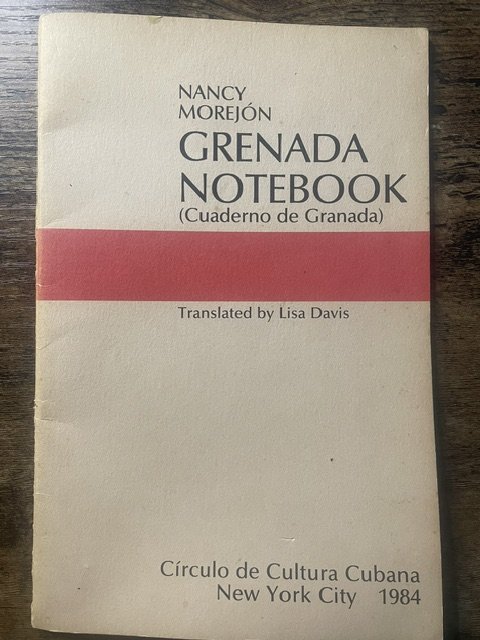
Photo of Nancy Morejón’s Grenada Notebook (Cuaderno de Granada) by Randy K. Gill-Sadler.
Morejón’s letter continues elegiacally and speculatively. Where the Grenada Notebook ends with the poem “A Simple Truth,” paying homage to the Cuban construction workers who defended Grenada during the invasion, Morejón continues to mourn them in the letter. She tells Jordan that the murdered construction workers’ bodies will be returned to Havana that same day and that it was “hard to accept that they were dead.” [13] The continuance of U.S. imperial violence, however, was easy to accept as Morejón speculated that an invasion of Nicaragua was now certain. “We are sure that they are going to invade Nicaragua, directly or not,” she writes. [14] She clarifies as she continues: “Probably not. They will use Honduras and Guatemalan forces.” [15] Morejón’s speculation harkens back to two lines in the “Requiem” poem. In it, the speaker declares awareness of how the “ranger from hell” operates: “The Caribbean recognizes your stance. / The Caribbean recognizes your cunning tricks.” [16]
The speaker presents a Caribbean region whose unification is premised on a shared recognition of the United States as a death bringer. Morejón’s use of anaphora further emphasizes this recognition and suggests that what happened in Grenada is relevant to the entirety of the Caribbean. While the poem’s speaker highlights Grenada’s significance to the region, Morejón articulates Grenada’s significance to the entire hemisphere to Jordan. For Morejón, an invasion of Nicaragua is imminent, and just as the United States used Barbadian police forces to assist with the invasion and capture of the remaining members of the People’s Revolutionary Government, it would employ Central American forces to invade Nicaragua as well—another cunning trick, so to speak. [17] In this way, the scale of the letter becomes hemispheric, and its functions include intimate grieving alongside vigilant, informed speculation on U.S. imperial moves.
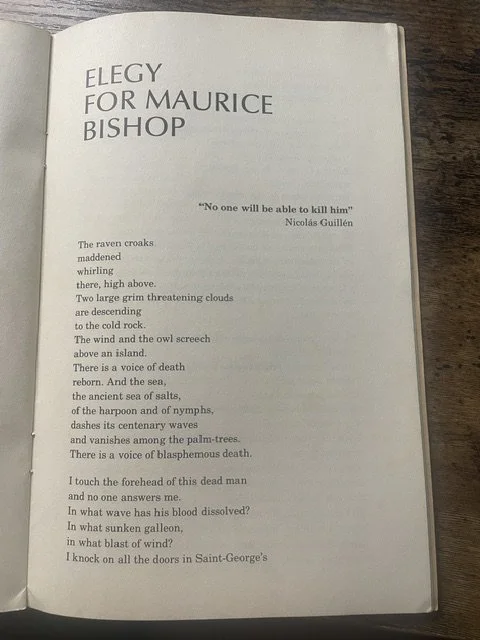
Photo of Nancy Morejón’s poem “Elegy for Maurice Bishop” in Grenada Notebook (Cuaderno de Granada) by Randy K. Gill-Sadler.
Morejón’s grief for Grenada and fear for Nicaragua compel her to give June Jordan a very specific directive: write. Writing, for Morejón, was a necessity. More specifically, that Jordan continue writing was necessary. “Don’t give up dear. Don’t give up dear,” Morejon implores. [18] She follows with an inquiry about whether Jordan had finished her essays on Nicaragua. It is more than likely that Morejón was referring to “Nicaragua: Why I Had to Go There,” which was published in the January 1984 issue of Essence magazine. [19] I interpret Morejón’s insistence that Jordan should keep writing as both a word of encouragement and an announcement of their shared hemispheric, anti-imperialist poetics. If in fact the U.S. was going to invade Nicaragua next, Morejón, even in her grief for Grenada and Cuba, was already co-organizing Nicaragua’s poetic defense alongside Jordan. Jordan would, in fact, go on to publish her Nicaragua essays and poems for Nicaragua and Grenada in Living Room.
Jordan’s “Another Poem About the Man” simultaneously mourns for Grenada in the aftermath of invasion and unflinchingly catalogues it as yet another instance of death in Reagan’s hemispheric reign of terror. “The man who brought you the garbage can,” the poem’s speaker asserts, “the graveyard/ the grossout/ the grimgram/the grubby grabbing/bloody babbling nightly news/ now brings you/Grenada.” [20] The alliterative, unpunctuated lines of the poem reveal a seemingly never-ending trail of imperial carnage that Grenada has been added to. “The man,” like Morejón’s “ranger from hell,” is both an environmental threat and destroyer of Third World self-determination, all while declaring his love of freedom and democracy. Liberation poetics, then, according to Morejón’s and Jordan’s poetry and letters, must name the scale and scope of his violence clearly and truthfully while marshalling every literary element at their disposal—the word, the image, the line, the stanza—to mobilize anti-imperialist resistance.
“ If in fact the U.S. was going to invade Nicaragua next, Morejón, even in her grief for Grenada and Cuba, was already co-organizing Nicaragua’s poetic defense alongside Jordan.”
Nancy Morejón’s and June Jordan’s liberation poetics are accompanied by, and are the outcome of, transnational, anti-imperialist solidarities. They both model a poetics that is not circumscribed by the nation-state, region, and their accompanying identities. Their hemispheric approach to anti-imperialism recognizes fidelity to the nation-state as yet another “cunning trick” of empire. Such wisdom is urgently necessary in the contemporary moment. Morejón and Jordan are also instructive in that their poetry and letters don’t solely focus on politicians and/or state actors. They ask us to be in anti-imperialist solidarity with the construction workers, the migrant labourers, the unnamed civilians, and those who valiantly and unashamedly take up arms against imperial forces.
Our current moment requires similar poetics of solidarity with fishermen and fisherwomen, civilians, tourist industry workers, and those fighting against U.S. empire from Venezuela, to Cuba, to Palestine. Their friendship illustrates that some anti-imperialist solidarities and poetics exceed what can be known by way of the published record. For those of us invested in organizing, maintaining, and extending anti-imperialist literary histories, we must be expansive in the materials we study and analyze and be willing to study and scaffold aesthetics and poetics that might not immediately appear to be associated with empire and its dismantling. May our own resistance be as rich and empowering as the epistolary poetics of Nancy Morejón and June Jordan. May we be the keepers of a garden that blooms an anti-imperialism as steadfast as it is beautiful and that nurtures freedom fighters for years to come.
Endnotes
[1] “June Jordan’s Garden” was originally published in a special double issue of The Black Scholar journal entitled “Black Women Writers.” This special issue featured poetry from the 1997 “Yari Yari’: Black Women Writers and the Future- An International Conference on Literature by Women of African Descent” Conference. It was also reprinted in a 2001 issue of the journal Callaloo.
[2] Morejón, Nancy. “June Jordan’s Garden.” The Black Scholar, Vol. 29, No. 2/3, 1999, pp. 26.
[3] Ibid.
[4] The Black Tulip (1850) is the name of an Alexander Dumas’ novel in which one of the major plot lines is a competition to see which character can grow a black tulip.
[5] “Jordan, June. “On Life After Life.” Living Room: New Poems. Thunder Mouth’s Press, 1985, pp.117.
[6] “National Council for Black Studies, Inc. Holds Seventh Annual Conference in Berkeley, California.” The Black Scholar, vol. 14, no. 3/4, 1983, pp. 56–57. Nancy Morejón attended the 1983 National Council Black Studies Conference in Berkeley, California, in 1983. Although this was six years prior to the beginning of Jordan’s tenure at Berkeley, given her own commitments to Black Studies, it would not have been unreasonable for them to have crossed paths here.
[7] The Black Scholar was integral to facilitating relationships between Black women across the diaspora in the 1980s. The Black Scholar published translations of Morejón’s poetry and sponsored Morejón’s 1985 U.S. book tour for her Where the Island Sleeps Like Wing poetry collection. For more on her book tour, see Beal, Frances M. “Nancy Morejón Tours U.S. To Promote New Book,” The Black Scholar, vol. 16, no. 4, 1985, pp. 62–63. Additionally, the journal also organized a delegation of Black women writers to travel to Cuba. For more on that trip, see Cortez, Jayne. “A Black Scholar Project: Black Women Writers Visit Cuba.” The Black Scholar, vol. 16, no. 4, 1985, pp. 61–61.
[8] While I use “transnational feminist” to describe these moments, it is important to note that Morejón did not always refer to herself as a feminist and felt more connection to Alice Walker’s term “womanism”. She explains, “In our Western world there are certain feminist movements that I respect very much as a woman, but sometimes they don’t get to the real point of our time and our societies. They develop ideas that belong maybe best to a consumer society.” For the full discussion, see Fido, Elaine Savory and Morejon, Nancy. “A Womanist Vision of the Caribbean. An Interview.” Out of the Kumbla: Caribbean Women and Literature, edited by Carole Boyce Davies and Elaine Savory Fido, Africa World Press, 1990, pp. 265-269.
[9] Morejón, Nancy. Grenada Notebook (Cuaderno de Granada). Translated by Lisa Davis, bilingual edition, Círculo de Cultura Cubana, 1984, pp.10.
[10] Ibid. 14. Also, Point Salines is the airport that American officials claimed what being expanded for military action and used that lie to justify the invasion. The airport’s name was alter changed to Maurice Bishop International.
[11] Morejón, Nancy. “Letter to June Jordan.” 12 November 1983. Folder 18, Box 39, June Jordan Papers, 1936-2002, Schlesinger Library, Radcliffe Institute, Harvard University, Cambridge, MA.
[12] Ibid.
[13] Ibid.
[14] Ibid.
[15] Ibid.
[16] Morejón, Nancy. Grenada Notebook (Cuaderno de Granada). Translated by Lisa Davis, bilingual edition, Círculo de Cultura Cubana, 1984, pp.14.
[17] This speculation can also be read alongside Audre Lorde’s “Grenada Revisited: An Interim Report.” Just as Lorde pointed out that the U.S. conducted a practice run of the invasion of Grenada in the military exercise Ocean Venture in Vieques, Puerto Rico as early as 1981, we might read Morejon speculation as a suggestion that U.S. acquired valuable information on how to mobilize a transnational military force against leftist regimes in the hemisphere from what happened in Grenada.
[18] Morejón, Nancy. “Letter to June Jordan.” 12 November 1983. Folder 18, Box 39, June Jordan Papers, 1936-2002, Schlesinger Library, Radcliffe Institute, Harvard University, Cambridge, MA.
[19] Jordan also published “Black Folks in Nicaragua: ‘Leave Those Folks Alone” in The Village Voice in 1983, which would have been before Morejon’s letter.
[20] Jordan, June. “Another Poem About the Man.” Living Room: New Poems. Thunder Mouth’s Press, 1985, pp. 109.