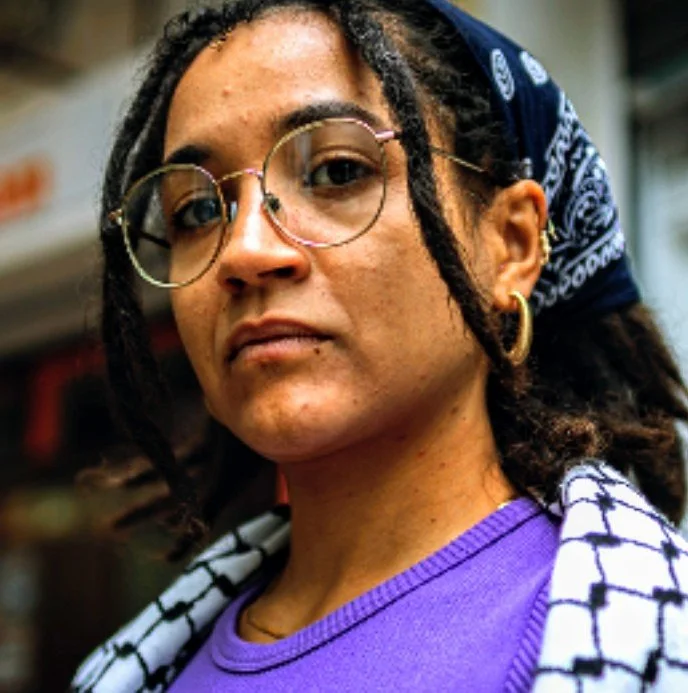
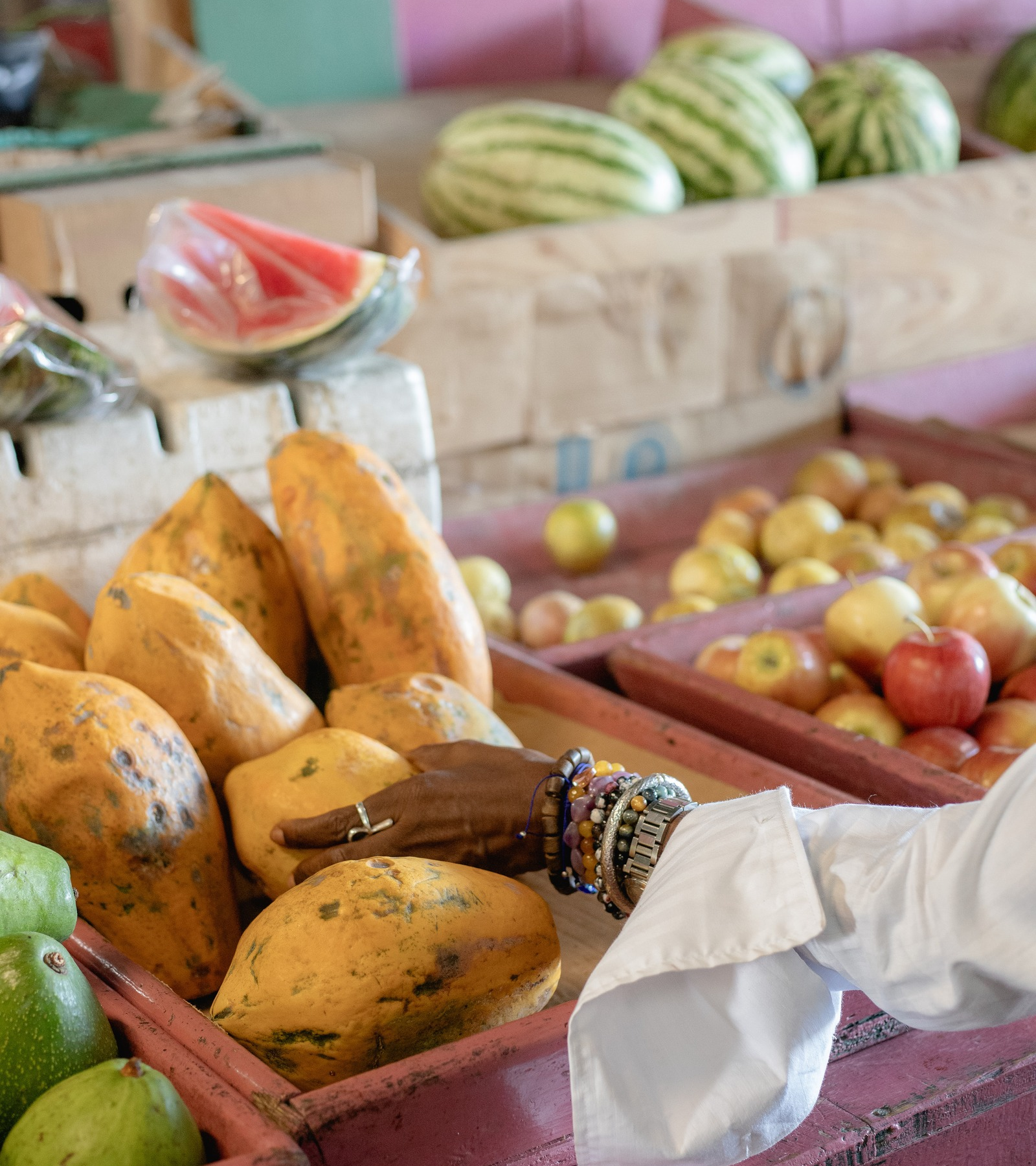
Photo by Zayne Airall, Intersect Antigua-Barbuda.
"The problem of how to think diaspora as more than people and movement—" they read.[1] Doux-Doux remembered that lesson, with Granny and Abeni, discussing how diaspora mek Caribbean and Caribbean mek diaspora. And here again, this lesson is connected to diaspora...Was this writer Caribbean?
The water lapped on the sand beneath the coconut tree Doux-Doux was lying on, reading about Black emancipation and on-to-lo-gy (wha(t) dis word is boi?)—“High tide on the way! Time for lessons.”
Slowly, they eased down the tree. Their body was growing, limbs extending, blood weeping, so that made them fear they could stain the ocean red...Nightmares come too, or were they memories? Of silent terror on ships jammed in with other bodies; of unbearable pain and agony. It feel like some days Doux-Doux have to move slow to hold the memories lingering in their body—Tanty say the body does remember tr-auma fuh longer.
Today is a slow day.
Today, Doux-Doux walks along the beach lined with samaan and manchineel trees—sand and water sifting through their feet as they move from the beach t(h)rough the path to the Maina.
Agwé meets Doux-Doux at the first immortelle—in bloom, yuh could smell rainy season coming.
From that first immortelle, the Maina, hive of their collective, stretched out far leading into town.[2] A sapodilla tree called out to the skies and keskidees begged their eternal question: wha' dey saying? Books spilled out from branches of trees and stacked themselves around plants, fed into the soil that they walked on. Doux-Doux and Agwé walk slow. Somebody did leave half a pawpaw beside a cassette player reading out Dark Laboratory by Tao Leigh Goffe.[3] Somebody will come back to that cassette player and no pawpaw. Giggling, Doux-Doux and Agwe quicken their pace closer to the centre of the garden.
There, a silk cotton tree rising from among a nest of books hollowed by time, sits an elderly woman, water to one side, a stack of books and a radio to the other, with an eyebrow raised.
"Doux-Doux dahlin’, Agwé, tek up that calabash over deyso, clean yuh faces and hands fuh me please. I doh want to feel sticky pawpaw on these records," she admonished.
"Sorry Granny,” Doux-Doux replied. "We saw some fruit and couldn—"
"Eh-heh, allyuh nyam up somebody pawpaw, I done know that. Now come, sit close. Yuh bot(h) have Walcott wit(h) you? Good, bring that radio closer too. No, not dat one, the next one. There."
Granny was blind. The kind of blindness where no light filtered through, where her ears, hands, feet, and plenty-something years embodied vision. Her experience of Caribbean identity and womanhood had made her a teacher and a mother before that was even her choice. She was the doyenne of the Maina and perhaps as old as the silk cotton tree that bolstered her.
“There, a silk cotton tree rising from among a nest of books hollowed by time, sits an elderly woman, water to one side, a stack of books and a radio to the other, with an eyebrow raised.”
"Agwé, tell me somet(h)in Walcott say in he book that mek you t(h)ink," Granny asked.
"I not done with the book yet, titja! What I read so far, The Long Emancipation, mek me t(h)ink plenty ‘bout what emancipation had to do wi(T)d the becoming of Caribbean societies, and about what it took for our communities to build better...But what I still doh understand. What onTOOlogy mean?"
"It is pronounced on-toh-logy Agwé, but it is a good start to t(h)inking about the place of emancipation in practices of freedom and humanity in the Caribbean. Now, listen good, yuh hear?"
“Ontology means a way of being human in this world. What mek we human? This is part of what Walcott talks about in his ‘long emancipation.’ He says how “emancipation is a legal process and term that I [the writer, eh] will argue marks continued unfreedom, not the freedom it supposedly ushered in.”[4] What did this mean for Caribbean communities’ own liberation? Now, we time short today, and Walcott is plenty theoretical, so we will answer what we could from our grounding. Fuss’, we mus’ put weself in a time an’ place: what was Emancipation?”[5]
““It is pronounced on-toh-logy Agwé, but it is a good start to t(h)inking about the place of emancipation in practices of freedom and humanity in the Caribbean. Now, listen good, yuh hear?” ”
Agwé gestured to Doux-doux to start.
“Spread across the mid-19th century, Emancipation was an event that signalled the end of a form of enslavement.[6] Black peoples in the Caribbean, part of what used to be called the Americas, those who had been marked as chattel property since their trafficking or their birth, were no longer property to be owned—” Doux-doux paused as they shivered, a memory of blood and horror, spasm-aching their foot, continuing, “but the economic and agricultural systems put in place by enslavement, were reproduced.”[7]
Agwé continued, “Emancipation did not mean complete freedom, only modifying the terms and conditions of ownership, as with the Apprenticeship system from 1834-1838 for example.”[8]
“And thas only the British process,” Doux-doux adds.[9]
“Correc(t) is right.” Agwé continued, “Walcott says that ‘the time of the long emancipation continues to tie Black people to the regimen of slave and plantation logics and economies.’[10] I listened somewhere else that even if enslaved peoples were freed, they were freed on still-occupied land.[11] So, the Plantation system continued?”
Granny nods, “Mmmhmm, a good start. I know in yuh gardening lessons you learn about Lloyd Best and George Beckford with Uncle, yes? Tell me what you learn about Plantation then Doux-doux.”
“Yes! Uncle teach us about what Plantation did to our lands, ripping up the relationship between our more-than-human beings, and expl-oiting the land solely for extra-ctive purpose.[12] The ecosystems of lands were erased to produce one or two crops massively, all ex-ported to the colonising metro-pole, with everything needed for the survival of the island and inhabitants, free and unfree, imported.[13] Kat’rin McKittrick talk about Beckford too, saying—” Doux-doux picked up the paper next to them, “that his
‘plantation thesis uncovers the interlocking workings of modernity and blackness...while also centralising that the idea of the plantation is migratory.’” Doux-doux finished.[14]
“I remember reading in the living archive an elder in reparatory justice that write about the ‘production of space and difference,’ where the plantation system was a tool fa’ marking where waste lived and how—and ‘waste’ meaning peoples seen to be ‘waste.’[15] That what McKittrick mean by ‘uneven racial geographies’?[16] So, rooted in the plantation system, come global versions of spaces where certain lands and bodies are ‘waste’? So the ‘plantation thesis’ migrates, but ent that would leave a trace even past the system self?” Agwé added.[17]
“Where we are now, Benitez-Rojo talk about the Caribbean as a region built for the per-pet-u-a-shon of plantation, that Caribbean development was modelled by Europe exclusively for the continuing extra-ctive profit of plantation.[18] Benitez-Rojo’s argument lead us to overstand that if the Caribbean was built for the Plantation then our archipelago could not exist without that system.[19] Who we were was erased so we could be ready for disposal at any time,” Doux-doux added, laying down La Isla Repetida close to Granny.
“The ‘entirety of the colonial project’? Stopping after independence then?” Granny intervened. “Remember to t(h)ink critically: you t(h)ink the lasting structure of plantation stopped in the Caribbean at the moment of independence? That, as Agwe aksed, there were no traces past the legal and physical presence of that system?”
Pause. Ahem.
“I think,” Agwé begins, “that McKittrick, Beckford, Ferdinand, and Benitez-Rojo speak to each other. And to Walcott too. If we say that colonial systems lasted fa’long as the colonisers were there, then there is no understanding of the deep harms caused by these trau-mas. So, as the Caribbean was built for the purposes of Plantation, that particular relationship of land, inhabitants, and policy lasted into the socio-economic systems of the 20th and 21st century. Gwanmanman, how was this experienced?”
“But this come too to Walcott’s idea,” Doux-doux jumps in, “of unfreedom continuing past 1834. If the Plantation system was re-pli-kted then the conditions of unfreedom that were violently im-printed on the estates were also mo-dulated. I remember from teacher bell that the unfreedoms in Plantation were embodied in the existence and survival of Black women.[20] So ent the systems trained from the Plantation were d-fined not only by that space self, but by the violence infl-fl..in-f-flited on Black enslaved women?[21] So when Walcott talk ‘bout enslavement made by the de-humanisation of Black bodies...”[22] Pause. “Ent that also mean that the de-humanisation of Black bodies...that de-humanisation all over cyah exist without the specific violences on Black women?”[23]
Doux-Doux shivers, back pain sharp with the phantom agony of being whipped face down on the ground, a hole dug to hold a uterus heavy with already-abused ‘property’[24]...They shiver again, the wind carrying music to their ears, under the palms of their hands. A tune, samplin’ Peter Tosh, vibrates through soil, running t(h)rough they body—‘Cause I’ma..man of the past and I’ma living in the present annndd...walking in the fut-ure!’[25]
Granny speaks calmly, “The dehumanisation of our ancestors translated to the dehumanising of Black and non-white bodies in contemporary contexts. This dehumanisation was deliberately structured, and its violent effects varied according to darkness, lightness of skin, according to prescribed and assigned gender, to class and geopolitical space...These variables, inscribed in such traumas as gender-based violence[26]—yes, that the word you were coming to Doux-Doux—colourism, sexism, racism, you will need to t(h)ink critically about, even if these fractures are now healing. In our archipelago, practices were collectively created across these fractures to build better, which we will come to when Abeni joins us. But even with this vocabulary of fractures and experiences, remember that our first trauma, the genocide of First Peoples, trafficking of Africans, chattel slavery, and indenture of South Asians...is not comparable to later, consequent trauma—”
“But! In the shadowing pain of their body and sleep Doux-doux does remember—”
“Thas different Agwe,” Granny says, sharply. “What Doux-doux knows, their bodily and sensory living of memory is a part of our stories—some ah we experience wha’ some ah we remember subconsciously. But mek no mistake Agwe, however your body stores the trauma of dehumanisation, yours are not its first experiences. Its first experiences were not those of your immediate ancestors of the 21st century either. The brutal racism, misogynoir and dehumanisation suffered by those of the 20th and 21st century were monstrous, and theirs to bear and resist, it was not the same as those of the 19th century. You could say our trauma operates like a palimpsest.[27] Forever re-experienced over the same ‘parchment,’ filtered new over similar foundations….We are storied humans, living archives of memory, that are all at once legacy and reality. You aksed about the Plantation system and the environment where we live; go back to the living archive and aks a storyteller about how Teacher Ida’s granddaughter name these experiences ‘land memory’ in our region[28]...The xomoi hauntings of racial and sexual trauma Doux-doux sometimes feel are part of this experience of memory...” Granny trails off after noticing an approaching figure, one that appears to bear fruit and water in their hands.
“Enitan,” calls Abeni softly. “You must eat something, I sure you had plenty to say for this lesson. You haven’t even reached the main thrust of Walcott’s argument: what (un)freedom have to do with ontology, his emphasis on Wynter’s beckoning to a ‘re-invention of the Human’ as decolonial praxis.”[29]
Enitan took the prepared fruit—their favourite, peewah—and water, passing the bowl around to Agwe and Granny. They lay back, light and birdsong filtering through the trees, kairi flitting around.
Grounded, Doux-Doux rises up, and—
“Wait, you just call me Enitan and not Alvita, Abeni?” they aks.
“Ayo! Yes, Enitan, the elders have found a name for you, if you will take it. But I will explain later, where were you at Agwé?”
“We talk about Walcott’s texts with Beckford, Benitez-Rojo, McKittrick and Ferdinand. We now moving to the on-tol-ogical part of what Walcott says,” Agwé elaborates.[30]
“You haven’t even reached the main thrust of Walcott’s argument: what (un)freedom have to do with ontology, his emphasis on Wynter’s beckoning to a ‘re-invention of the Human’ as decolonial praxis.”
“Ah, very good. And have they grasped what Walcott’s context for Black ontology was?”
Abeni turns to Granny.
“Not quite yet, although Doux-Doux will recognise some of these words from a previous lesson, ”she smiles.
“Ayo! You used to read much of Sylvia Wynter, their calls to the ‘re-invention of the Human’, remember Wynter places a capital ‘H’ on human, and a capital ‘M’ on Man.[31] She used this distinction to refer to the construction of a reality of who counted as human and who did not.[32] Through her texts from the Columban period of 1492—that too deep for our time, we have a copy somewhere mesh in with the pink poui tree Agwe—Wynter demonstrates how the supremacy of white men as the ‘Human’ was partly anchored in European Enlightenment philosophy, with ‘Man’ replacing any monotheistic divinity.[33] Naming trafficked Africans chattel, ‘furniture,’ was fundamental to imposing the extreme violence of an extractive mode of production that was transformed into the destructive force of racial capitalism that almost brought about the end of this world.[34] What Walcott reveals is that this ontology, shaped into global standard, was built while negating Black humanity.[35] That the ‘Human’ could not exist without the inhumanity, the ‘wasting,’ of ‘Black life-forms.’[36] And so Sylvia Wynter’s call to re-invent the human was all too urgent.” Abeni explains.
“Remember our last lesson Doux-Doux? I told you that Sylvia Wynter thought that ‘feminism needed to be understood through difference.’[37] I know you've been reading bell hooks and her history of the plantation in Ain’t I a Woman? Consider that bell hooks’ angle is mainly across the Empire known at that time as the US—”[38]
“Bu(t) hi? Dem ruins on Turtle Island used to be a h-empire?!” exclaims Agwe.
“Eh-heh, in fact we—us, this Maina, our human and more-than-human ecosystems—would not exist today if that empire was still intact.” Nodding, Granny turns back to Abeni.
“While bell hooks’ history focused on one of the most criminal imperial enterprises of our world's history, her ‘politics of care’ as integral to Black feminist praxis—‘x’ like practising theory and consciousness Doux-Doux, doh squint up yuh face so—was a part of other feminisms in our region. Caribbean feminisms understood that working laterally across spaces produced through difference[39]—” Abeni paused, smiling at Agwe’s face, lit up in recognition of that thought, “working intersectionally was non-negotiable in building any sustainable way of living and being together. Caribbean feminisms, voiced and collectively created by Black, yellow/black, brown/black, ‘not/white’ bodies, experienced the intersectionality of injustices and understood the heavy untangling necessary to practise being human across those fractures.”[40]
Doux-Doux intervenes. “So thas what Walcott meant! That is only by centering Black ways of being—he did call d(th)at v-er-na-cu-lar?[41]—d(th)at sustainable practices of freedom can arise worldwide. Black feminist and Caribbean intersectional feminisms sound like part of these ontologies, and sound like they were ne-ce-ssar-ily practised collectively as solidarity... Walcott talks plenty about diaspora then—was he Caribbean?”
“Very good,” Granny smiles, eyes wide, “Tell me about that, you sure about what you mean now?”
Agwé and Abeni turn to Doux-doux, waiting.
“Wynter talk of the making of new ‘nativities’ in the Caribbean.[42] That repeated process of trafficking, importing communities, forcin’ the cohabitation of diasporic peoples toget(h)er, also forced the necessary creation of new indi-ge-neities that are specific to each island, while connected to the rest of the arch-i-pel-ago. That relation-ship only possible from the effects and afterlives of enslavement and Plantation.[43] I aksed if Walcott was Caribbean because he considers the “problem of how to think diaspora as more than people and movement..." which was important to Caribbean communities making ourselves.[44] If ‘long emancipation’ prevented the becoming of Black freedom and humanity even past independence, and Caribbean feminisms were key to moving beyond this, how did this praxis inter-act with the powers that inherited the violent im-balance of the Plantation system?”[45]
Granny leaned further back into the silk cotton tree. “Ow chil(d), ow...This chil(d) meking sense inno!”
Abeni aksed Agwé, “anything you want to add, or respond?”
They thought carefully, instead aksing a next question: “this has to do with diaspora, fractured development in the Caribbean: was Walcott and everybody we spoke of today involved in the fights for justice happening in their time? With the movements organising in the Caribbean and in the Caribbean diaspora, or the trans-national solidarity spread out all over...? And how these movements speak to each other? What ‘praxis’ did they organise with? If the Caribbean was a place rooting and condensing the inherited, contemporary consequences of racial, colonial, ecological, gendered trauma—nd Caribbean histories and cultures manifest the difficulties in surviving within d(t)is—the joy in collectively creating other ways of being must not only center Black practices of liberation, but Caribbean feminist practices of liberation.”
““Caribbean feminisms understood that working laterally across spaces produced through difference...
working intersectionally was non-negotiable in building any sustainable way of living and being together.””
“Ayo!” Abeni rejoiced. “Very good, both of you! I can see your lessons at the archive are bearing fruit. Mmmhmm, listen good...”
Doux-doux and Agwe sat back, Lauryn Hill playing on a radio somewhere, keskidees and yellowtails chirping.[46]
Doux-doux smiled, thinking of their found name: Enitan. It mean a storied person. Their body is storied, as is their consciousness. Like riddims running t(h)rough their body, sometimes a throb, an ache, sometimes a thrill, pleasure...is that why they can feel and recall and experience the humanities of so many others, related to their heritage or not? Is it t(h)rough how they feel, vibrate, soun(d)?
Granny and Abeni’s lesson continues. Doux-doux is carried by the conversation, moving with the choreography of the silk cotton tree, like Moko Jumbie mas’. Ahead, immortelle bloom and water lapping thick and quick—rainy season coming.
Endnotes
[1] Walcott, Rinaldo. 2021. The Long Emancipation: Moving Toward Black Freedom. Durham: Duke University Press.
[2] Please refer to the glossary below for terms marked in italics.
[3] Goffe, Tao Leigh. 2025. Dark Laboratory: On Columbus, the Caribbean, and the Origins of the Climate Crisis. New York: Vintage Books.
[4] Walcott, Rinaldo. 2021. “Moving Toward Black Freedom.”The Long Emancipation: Moving Toward Black Freedom. Durham: Duke University Press, p. 1.
[5] When I use the term ‘grounding’, I mean it following this reference: Walter, Rodney. 2019. The Groundings with My Brothers, Verso Books.
[6] Walcott, Rinaldo. 2021. “The Long Emancipation.” The Long Emancipation: Moving Toward Black Freedom. Durham, Duke University Press, pp.35-43.
[7] “Transatlantic slavery along with the brutal theft of Indigenous territories is the engine that has driven capitalism and its various global incarnations for the past five hundred years”, Walcott, Chapter 6: “Diaspora Studies,” in The Long Emancipation, pp. 23-27, p.24.
[8] Walcott, Rinaldo. 2021. “The Long Emancipation.” The Long Emancipation: Moving Toward Black Freedom. Durham, Duke University Press, pp.35-43.
[9] Manjapra, Kris. 2022. Black Ghost of Empire: The Long Death of Slavery and the Failure of Emancipation. Simon and Schuster.
[10] Walcott, Rinaldo. 2021. “The Long Emancipation.” In The Long Emancipation: Moving Toward Black Freedom.
[11] Conversations with Prof Matthew Smith [UCL CSLBS] August 2024, as excerpts featured here.
[12] Ferdinand, Malcolm. 2022. “The Matricides of the Plantationocene.” Decolonial Ecology: Thinking from the Caribbean World. Translated by Anthony Paul Smith, Polity Press, pp. 36-48.
[13] McKittrick, Katherine. 2013. “Plantation Futures.” Small Axe: A Caribbean Journal of Cultural Criticism, Duke University Press, p.3.
[14] Ibid.
[15] Hawthorne, Camilla and Jovan Scott Lewis. 2023. The Black Geographic: Praxis, Resistance, Futurity. Duke University Press.
[16] McKittrick, Katherine. 2013. “Plantation Futures. Small Axe: A Caribbean Journal of Criticism, vol. 17, no. 3 (42): 1–15, https://doi.org/10.1215/07990537-2378892.
[17] Ferdinand, Decolonial Ecology, p. 44.
[18] Benitez-Rojo, Antonio. 1996. The Repeating Island: The Caribbean and the Postmodern Perspective. Duke University Press.
[19] Ibid.
[20] hooks, bell. 2014. Ain’t I a Woman: Black Women and Feminism, Routledge.
[21] Thompson Grunwald, Nyala. August 18, 2025. “Ain’t I a Woman Too? Groundings in Black Feminism And Gender-Based Violence Through Bell Hooks—Feminitt Caribbean,” Feminitt Caribbean.
[22] Walcott, The Long Emancipation.
[23] Walcott, “Diaspora Studies,” The Long Emancipation, pp. 23-27.
[24] Higman, B.W. 1986. Slave Populations in the British Caribbean 1807-1834, Anthony Hopkins Press.
[25] Pyramid, Kabaka. 2022. “Mystik Man.” The Kalling, https://bit.ly/3UgsUBd.
[26] Salami, Minna. 2020. Sensuous Knowledge: A Black Feminist Approach for Everyone. HarperCollins.
[27] A palimpsest is a parchment used, erased (but not completely) and written over from ancient history well through centuries sometimes. The result of these parchments were that you could see the layers of what was written, as well as see the end result at time of viewing.
[28] Nyala Thompson Grunwald, “No Man's Land': Mangroves, waters and 'land memory’ in Trinidad and Tobago.” Paper presented at the Association for Caribbean Historians, 25/05/2026.
[29] Wynter, Sylvia. N.d. Black metamorphosis: New Natives in a New World. Schomburg Centre for Research in Black Culture, New York, Institute for the Black World Records, Sylvia Wynter Papers.
[30] “What we might call ‘Black freedom’ is only possible in distinct opposition to capitalism, historically and presently,” Walcott, Chapter. 15: “I Really Want To Hope.” The Long Emancipation, pp. 65-69, p.65.
[31] Wynter, Sylvia. N.d. Black metamorphosis: New Natives in a New World.
[32] Ibid.
[33] Ibid.
[34] Robinson, Cedric. 2021. “The Historical Archaeology of the Black Radical Tradition.” Black Marxism: The Making of the Black Radical Tradition. 4th edition Penguin Books, pp. 121-167.
[35] “Sylvia Wynter’s numerous essays are central to thinking on the European invention and proliferation of a ‘New World’ (view) that European Enlightenment expansion ushered in for all of us.” Walcott, “Diaspora Studies,” The Long Emancipation, pp.23-27, p. 23.
[36] Walcott, Rinaldo. 2021. “Problem of the Human, or the Void of Relationality.” The Long Emancipation: Moving Toward Black Freedom. pp. 55-59.
[37] Wynter, Sylvia (n.d.) Black Metamorphosis: New Natives in a New World.
[38] Thompson Grunwald, “Ain’t I a Woman Too? Groundings in Black Feminism And Gender-Based Violence Through Bell Hooks—Feminitt Caribbean.”
[39] Hawthorne, Camilla A., and Jovan Scott Lewis. 2023. The Black Geographic : Praxis, Resistance, Futurity. Durham: Duke University Press.
[40] Salami, Minna. 2020. Sensuous Knowledge: A Black Feminist Approach for Everyone. HarperCollins.
[41] Walcott, The Long Emancipation.
[42] Wynter, Sylvia. N.d. Black metamorphosis: New Natives in a New World.
[43] Walcott, Rinaldo. 2021. “The Atlantic Region and 1492.” The Long Emancipation: Moving Toward Black Freedom, pp.27-33.
[44] Walcott, The Long Emancipation.
[45] Ibid, “We might have to think indigeneity as a more flexible process of critique and resistance to modernity rather than as an organic identity.”
[46] Hill, Lauren. 1998. “Everything is Everything.” The Miseducation of Lauryn Hill, https://bit.ly/47wbyU4.
Glossary
Keskidee. Creole for “qu’est-ce qu’il dit?”, French meaning, “what is he saying?” The bird is named such due to its song, that sounds like kes-ki-dee.
Maina. Translated from Kalinago as ‘Garden.’
Nyam. To ‘nyam’, Trini for the verb ‘to eat.’
Titja. Kwéyòl for ‘teacher.’ Kwéyòl vocabulary sourced from the Kéwyòl Dictionary, compiled by David Frank et al, Ministry of Education, Government of St. Lucia, https://tinyurl.com/mj3x2jyw.
Gwanmanman. Kwéyòl for ‘grandmother.’ Please see above for Kwéyòl source.
Xomoi. Translated from Caquetio (Arawak) as ‘phantom.’ First Peoples Caribbean languages sourced from Native Languages Organisation.
Sources
(A) Playlist
Cain Culto, Xiuhtezcatl, Snow Tha Product, ¡Basta Ya! (Snow the Product Remix), 2025.
Lauryn Hill, The Miseducation of Lauryn Hill, 1998.
Koffee, Gifted (Deluxe Edition) 2022.
Damian Marley, Stony Hill, 2017.
Kabaka Pyrmaid, The Kalling, 2021.
Xiuhtezcatl, TONATIUH, 2025.
(Some) Further Reading and Sources
Beckford, George. 2013. “Plantation Society: Toward a General Theory of Caribbean Society,” Caribbean Cultural Thought: From Plantation to Diaspora. Eds. Yanique Hume & Aaron Kamugisha. Ian Randle Publishers 2013, pp.109-12.
Benitez-Rojo, Antonio. 1998. La isla que se repite: el Caribe y la perspectiva posmoderna. 2nd edition CASIOPEA.
The Repeating Island: The Caribbean and the Postmodern Perspective, 2nd edition, translated by James E. Maraniss, Duke University Press, 1996.
Best, Lloyd. 2013. “Independent Thought and Caribbean Freedom,” Aaron Kamugisha, Caribbean Political Thought: the Colonial State to Caribbean Internationalisms, Ian Randle Publishers 2013, pp.317-337
Ferdinand, Malcolm. 2022. Decolonial Ecology: Thinking from the Caribbean World, translated by Anthony Paul Smith, Polity Press.
Glissant, Édouard. 1998. Le Discours Antillais, Éditions Gallimard.
Goffe, Tao Leigh. 2025. Dark Laboratory: On Columbus, the Caribbean, and the Origins of the Climate Crisis. New York: Vintage Books.
Hawthorne, Camilla, and Jovan Scott Lewis. 2023. The Black Geographic: Praxis, Resistance, Futurity. Duke University Press.
Higman, B W. 1986. Slave Populations in the British Caribbean 1807-1834, Anthony Hopkins Press.
hooks, bell. 1998. Ain't I A Woman? Black Women Feminism, Pluto Press.
Manjapra, Kris. 2022. Black Ghost of Empire: The Long Death of Slavery and the Failure of Emancipation, Simon and Schuster.
McKittrick, Katherine. 2013. “Plantation Futures,” Small Axe, Duke University Press, 2013, pp.1 -13.
Meeks, Brian. 2023. After the Postcolonial Caribbean: Memory, Hope, Imagining, Pluto Press.
Robinson, Cedric. 2020. Black Marxism: The Making of the Black Radical Tradition, 4th edition, Penguin Books.
Rodney, Walter. 2019. The Groundings with my Brothers, Verso Books.
Salami, Minna. 2020. Sensuous Knowledge: A Black Feminist Approach for Everyone, Bloomsbury Press.
Smallwood, Stephanie. 2009. Saltwater Slavery: A Middle Passage from Africa to American Diaspora, Harvard University Press.
Thompson Grunwald, “Ain’t I a Woman Too? Groundings in Black Feminism And Gender-Based Violence Through Bell Hooks — Feminitt Caribbean,” Feminitt Caribbean, August 18, 2025.
“‘No Man's Land’: Mangroves, waters and 'land memory’ in Trinidad and Tobago,” paper presented at the Association for Caribbean Historians, 25/05/2026.
Walcott, Rinaldo. 2021. The Long Emancipation: Moving Toward Black Freedom, Duke University Press.
Wynter, Sylvia. N.d. Black Metamorphosis: New Natives in a New World. Schomburg Centre for Research in Black Culture, New York, Institute for the Black World Records, Sylvia Wynter Papers.