

Writing a Revolution
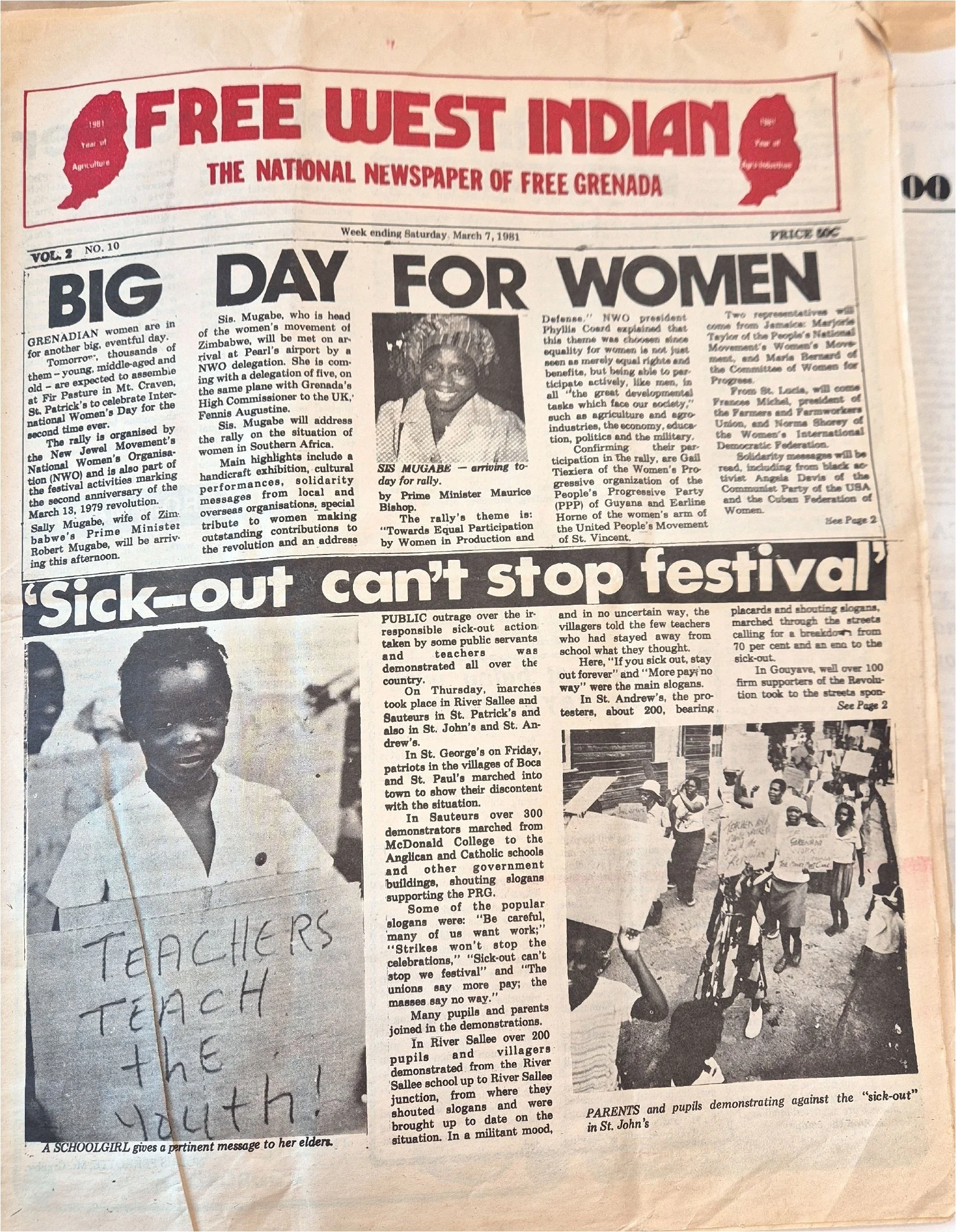
Photo the 1981 cover page of volume 2, number 10, of the Free West Indian newspaper. Accessed via the CERLAC Special Collection, Thematic Section on Churches, York University, Toronto, Canada.
A smile lingers as Merle Hodge studies the faces of the women captured in a scan of a newspaper article. Dated Sunday, March 7, 1981, the piece is captioned, “The New Caribbean Woman,” and provides a snapshot into the lives of six women who came to Grenada from across the world to dedicate their time and talents to the revolution.
Hodge is among those featured. Among other notable literary works, she is the author of Crick, Crack, Monkey, a novel published in 1970 that serves as an introduction to her for many of us educated in the Caribbean. In the photo, a young Hodge sports a neat, natural hairstyle, and a serious demeanour: a woman about her business. The woman looking back at her is crowned with salt and pepper locs reaching to her midback. She is dressed casually for our conversation at her home, which is one of the family houses on the property, spanning across generations.
An article published in Free West Indian on March 13, 1980, described Hodge as “one of the better-known Caribbean professionals...working in Grenada and serving the revolution,” going on to describe her “as one of the most intelligent and clear-minded writers in the region.” Perhaps it was because she was one of just a few women who provided consistent social and political commentary in regional publications during a pivotal time in Caribbean development. She was a frequent contributor to key regional newspaper publications in circulation during the time of the Grenadian revolution: The Free West Indian, the official newspaper of the People’s Revolutionary Government (PRG), and Caribbean Contact, a progressive regional imprint operated by the Caribbean Council of Churches (CCC). In this way, Hodge was able to write the revolution in overlapping, yet intersecting ways. First, she wrote the revolution from within, storying the ways that systems and institutions were changing to promote social progress, particularly for women and girls. Second, the prolific Caribbean writer wrote as revolution, ensuring that women’s voices on Grenada were not ignored, inked beyond the borders of the island state. Hodge’s pen was sharp but fair, and brought with it the turn of phrase that seemed to come easily. Ironically, Hodge did not realise that she was one of the few women writing the revolution in such a meaningful way.
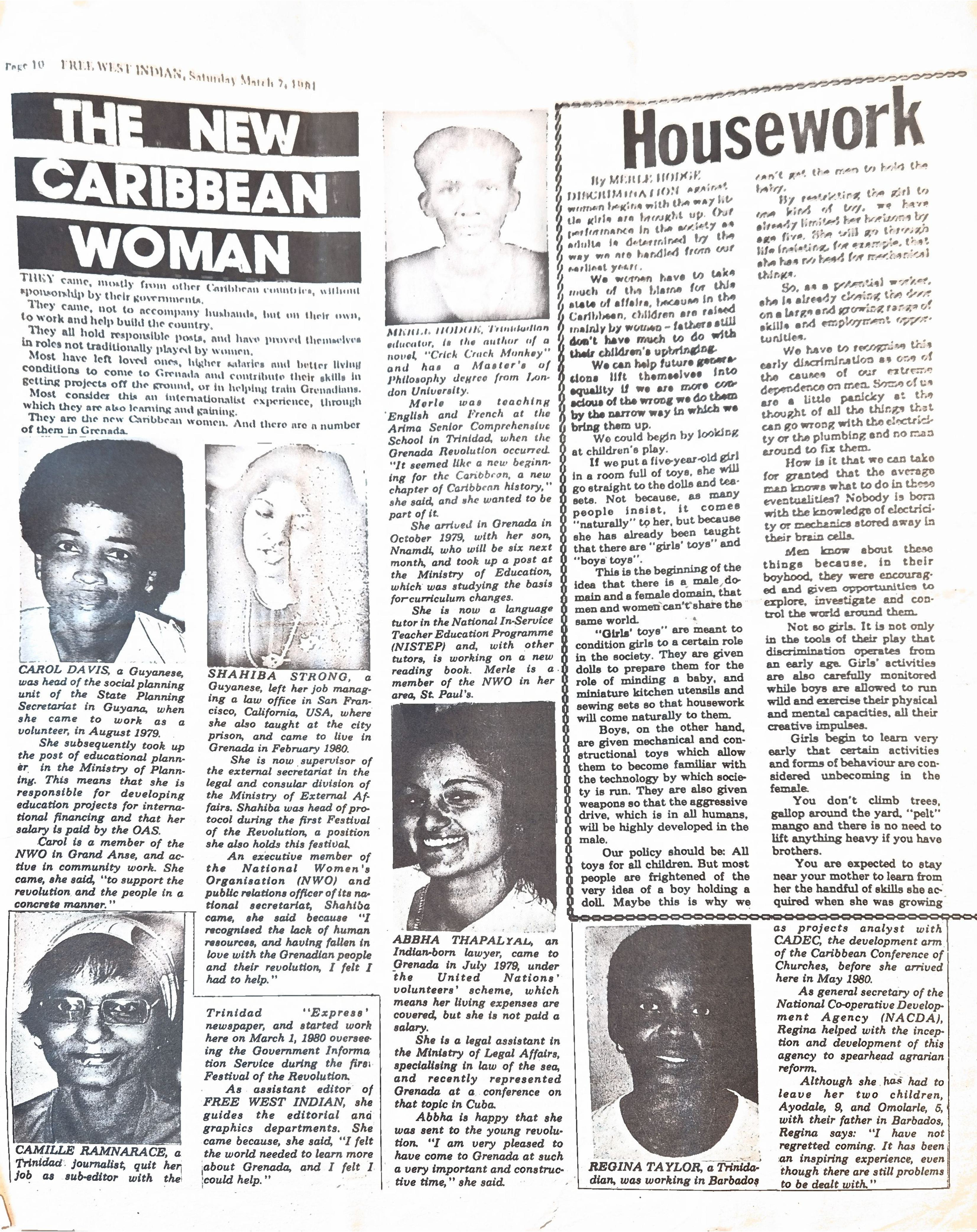
Article accessed via the CERLAC Special Collection, Thematic Section on Churches, York University, Toronto, Canada.
“I already had an interest in literature,” she said. “So I just think that the writing skills are there [and] you could apply those skills to activism. And it's probably Jackie (Jacqueline Creft) who also pushed me into it.” Creft was a close friend and the Minister of Education, Youth, Women’s and Social Affairs, Culture, Sports and Community Development in the revolutionary government. They met and became friends in Trinidad, where Creft worked for the Caribbean Council of Churches.
“First, she wrote the revolution from within, storying the ways that systems and institutions were changing to promote social progress, particularly for women and girls. ”
Hodge also credited her willingness to speak out to adopting part of her father’s personality. “...My mother and father were very badly matched; they weren’t the same kind of people at all,” the author and critic says with a laugh. “... My father was very gregarious, and my mother was very reclusive in a way. So I concluded that I am these two people; I am half and half. I was gregarious when I was young....I have a little bit of that left—not much... but I still have some there.” The women she grew up with also provided wonderful examples of being in charge of whatever they did. “The women around me when I was growing up didn't suggest anything about inferiority... and there were some of them [that] could take on any fight with a man. They were just not easy, you know! They were so much in charge.”
Despite being surrounded by powerful role models, Hodge was still very aware of the inequalities that women faced in the Caribbean at the time, particularly as it related to access to economic and political power. She placed these concerns into the printed press with a piece cheekily titled: “Women’s power in the West Indies? Man, you must be joking!” published in the July 1979 edition of Caribbean Contact.
“Caribbean women are yet to properly enter politics. Certainly, we have participated in the political life of the region from the beginning. Our participation in political campaigns from the era of slavery to the present day has been so crucial that we are often described as the ‘backbone’ of these movements. [W]omen have given their vigorous support: marching, picketing, striking, raising funds, distributing leaflets, campaigning door-to-door, going to jail or getting shot at.
“One is allowed out of the kitchen when there are battles to be fought, but what happens to the women after the struggle, after their participation has helped to take the cause to victory? Women tend to find themselves back to square one, unless the movement they worked for has genuinely counted them as equal from the start or unless they themselves refuse to melt back into the shadows. Otherwise, their position in the ‘new society’ remains much the same as it was before the ‘change’ for which they fought. This is why women in the Caribbean should not content themselves for much longer with their ‘backbone’ role. They should be equally represented at the head, so that their impact is felt at the centre of decision-making. For as long as women consent to carry out decisions and never make them; for as long as they fall to influence the thinking of political movements and help shape the ideology of the causes they support, they will find that they are liable to be used by movement after movement.”
— Merle Hodge
Living and working in Grenada during the revolution as a tutor in National In-Service Teacher Education Programme (NISTEP), and later as a consultant on curriculum reform, Hodge saw firsthand how women’s lives could be improved through efforts at transforming the institutional arrangements that also impacted their lives. This was done through women’s access to political decision-making, supported by policy statements from the revolutionary government to advance women’s development. As Barriteau and Clarke notes, a policy abolishing sexual exploitation of women was proclaimed on the 20th of March 1979. Three months later, a women's desk was established in the Ministry of Community Development, which later grew to a Women's Affairs Division. [1]
Just as important was the work done by National Women’s Organisations (NWO). In its heyday, membership stood at 6,500 women organised in 170 groups, with eleven groups in Carriacou and one in Petit Martinique. [2] Hodge was a member of the St. Paul’s arm of the NWO. The organisation regularly supported families in need, supplying items such as school books, powdered milk, and cooking oil. In addition, the organisation was at the vanguard of road repair initiatives, building of community centres, community clean-ups, and island-wide beautification programmes. [3] Popular education and literacy campaigns for both children and adults were also undertaken as a means to improve the lives of people in poverty.
A study conducted in the aftermath of the revolution’s tragic end, conducted by Eudine Barriteau and Roberta Clarke in 1989 [4] found that about half of the participants felt that conditions of living had improved for them under the revolutionary government. Additionally, 75.5 per cent of the sample stated that conditions for women improved, with strong support for changes in the Maternity Leave Law of 1980, which gave women three months of maternity leave cover, as well as the right to job reinstatement at the end of this period. Grenadians also touted the March 1979 policy declaration regarding equal pay for equal work. [5]
As Hodge noted in her co-authored book, Is Freedom We Making, published in 1981, women were also in the “rank-and-file and leadership of the National Youth Organisation (NYO), the Parish Councils, the People’s Militia, and the various Community Action or Community Development bodies which have sprung up since the Revolution. Women are also part of the changing role of other organisations like the Trade Unions and the Catholic Youth Organisation, which have taken on an increasingly political role in the participatory climate of the Revolution.” [6]
Additionally, commemorations like International Women’s Day became hallmarks on the national calendar and were used to highlight how women were making advances under Bishop’s rule. Speakers at rallies included the late Sally Mugabe [7] and radical feminist activist and scholar, Angela Davis. [8]
It is clear that women were in the engine room of the revolution. However, they were also responsible for the invisible labour that was underwriting its success. The strain of the double work soon caused fissures in the family, Hodge remembered:
“Some women were saying that their children were telling them that when they get bigger, they're not going in no meetings at all because they were pushing too hard... Because their mother was always in some damn meeting, working all over the place. The women deployed themselves into the revolution.”
“But of course the women were taking on more than the men, so they started to run out of energy... apparently that was happening with everybody, but the women in particular would have considered themselves more vulnerable, because they have children to deal with... And the men weren’t taking enough part in the children’s upbringing, so the women were carrying a lot of the load of the development of the party and the revolution, as well as their homes.”
— Merle Hodge
The defiance and quiet confidence of the young Merle Hodge depicted on the pages of Caribbean Contact seems to have remained unchanged over the years. Hodge has added significantly to the scholarship on Caribbean family forms, mediated through the fields of sociology and gender studies. She also continued to be an avid social commentator upon her return to Trinidad and Tobago.
Reflecting on my day with Hodge also brought me back to a conversation I had a few days ago with a young student from Grenada. When she mentioned she was from the Spice Isle, I couldn’t help but tell her about what I was working on. I asked what she learned about the revolution while growing up, and more specifically, what women’s roles were in the movement. She lamented the fact that there seemed to be more of a will to forget; captured in five simple words: “I wish I knew more.” This erasure robs young women like the one I spoke with of the opportunity to learn of the rich lineages coursing through her veins. She deserves—we all deserve—more than incomplete histories told only in weeping, gunshots, and praise of imperialist impositions. As the region confronts its new permutations of US imperial control, we must return to the stories of the times when we dared to dream of new worlds—and hold our pens steady to once again speak truth to those who need to hear it most.
Endnote
This work was made possible by the Oxfam Blueprints for a New Economy Fellowship. Sincere thanks go out to Maaza Seyoum and Professor Grieve Chelwa for their guidance, keen eyes, and open minds.
Works Cited
[1] Barriteau, E., & Clarke, R. (1989). Grenadian Perceptions of the People’s Revolutionary Government and its Policies. Social and Economic Studies, 38(3), 53–91. http://www.jstor.org/stable/27864889
[2] Phillip-Dowe, N. (2013). Women in the Grenada Revolution, 1979–1983. Social and Economic Studies, 62(3/4), 45–82.
[3] Ibid.
[4] Barriteau, E., & Clarke, R. (1989). Grenadian Perceptions of the People’s Revolutionary Government and its Policies. Social and Economic Studies, 38(3), 53–91. http://www.jstor.org/stable/27864889.
[5] Ibid.
[6] Hodge, M., & Searle, C. (1981). “Is freedom we making”: The new democracy in Grenada. Government Information Service.
[7] The Free West Indian, Week ending March 7, 1981. Volume 2, No. 1.