

A Call for Papers
Intersect Antigua-Barbuda is pleased to present A Contrapuntal Plot: Caribbean Feminisms Against Cultural Imperialism, a Virtual Graduate Student Symposium. We invite submissions in which scholars read and “plot contrapuntally,” through the work of Sylvia Wynter and Edward Said, focusing on gender, race, caste, class, nation, sexuality, and empire in literature, film, and TV.
Eligibility: We welcome submissions from graduate students, advanced undergraduate students, post-doctoral scholars, independent scholars, and faculty. We also welcome individual paper submissions, co-authored papers, and panel proposals of up to three people.
Abstract Deadline: December 1st, 2026 at 11:59 AST/ET.
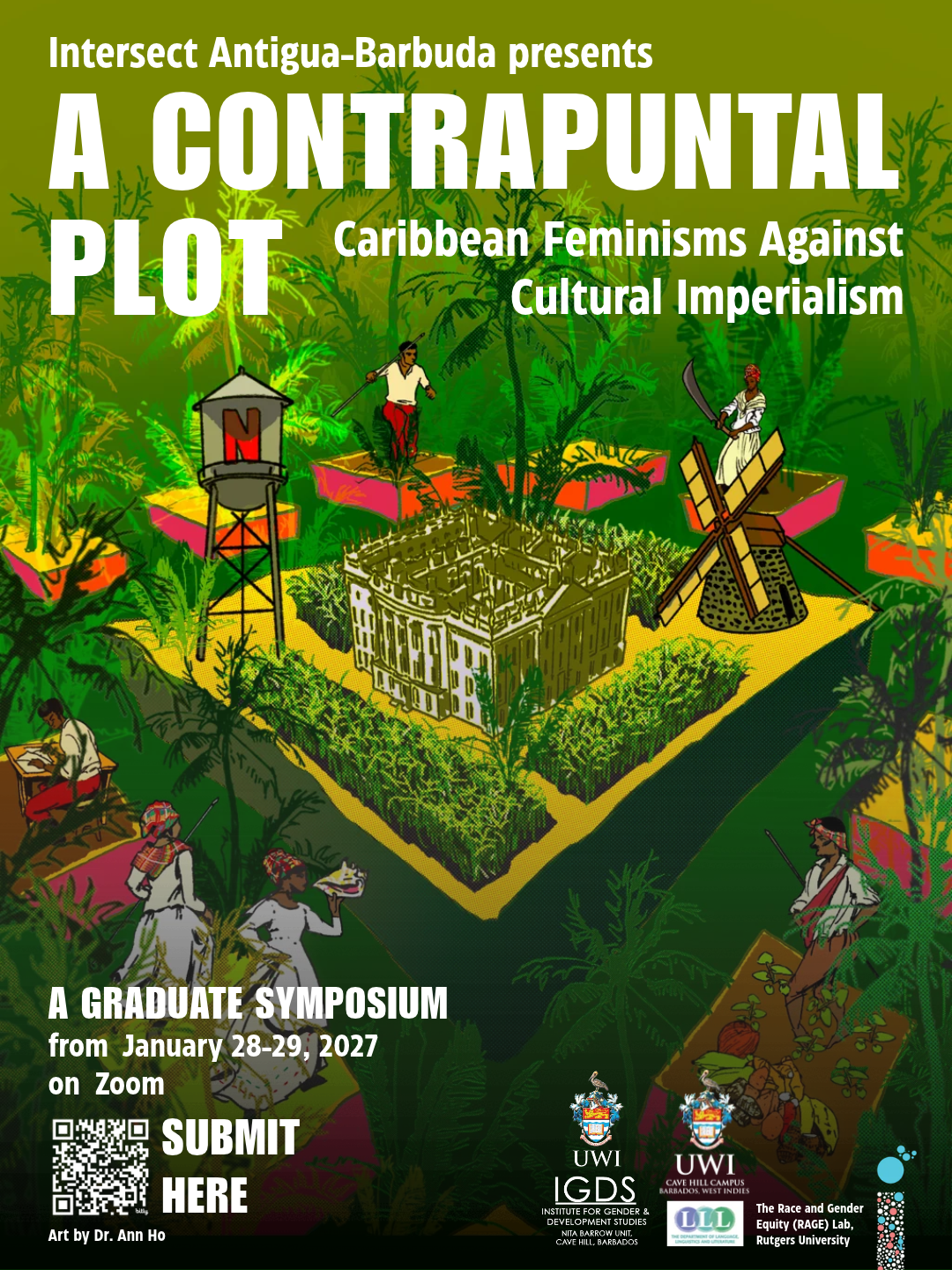
Access the CFP with visual aids.
About the Theme
First, there’s the plantation; a violent geography of Black subjection, the site of monocrop production like sugar cane, and the source of primitive accumulation and cultural production for the metropole. And then, there’s the plot: “provision grounds of yams and eddoes” (Lightfoot 2015, 43) that some among the enslaved could depend on for subsistence; a plot for food and placemaking; a plot that resisted the commodifying logic of the plantation; a plot for folk culture, and a plot against imperialism. Edward Said’s reading methodology of contrapuntality remains a vital tool for refusing imperialism’s cultural myths with a resistant, anti-colonial rigor. Originating from the musical term “counterpoint,” it refers to a method of literary interpretation and analysis of colonial texts that obscured the social, historical, and economic relations within the colonies, including wealth extracted from the plantation, that organized the metropolitan centers, gilded estates, and stately homes depicted in literature, including the 19th century “novel of manners.”
Writing in “Novel and History, Plot and Plantation,” Sylvia Wynter unsettled imperialism’s claims to cultural exceptionalism two decades before Said’s intervention with insights into the 20th Century West Indian novel and the plantation, writing that “the novel form and our societies are twin children of the same parents.” She compares the plot system with “the novel form in literature terms,” describing it as embodying a resistant logic to the plantation economy, and engendering a “folk culture.” Wynter thinks with, and anticipates, those novels which reconfigure the Caribbean’s relationship to empire’s cultural narratives. Jean Rhys’ Wide Sargasso Sea is a riposte against Jane Eyre’s madwoman in the attic. Toni Morrison “frets the cliché” in Tar Baby, set in an imagined Caribbean, and addresses racial dichotomies conceived “in line with the tradition of the fiction of manners” per Jane Austen (Serpell 2026, 98-9). Aimé Césaire centers an insurgent Caliban in Une Tempête, whereas Shakespeare’s Caliban is impotent in The Tempest, Maryse Condé reclaims the power of Kwéyòl in Windward Heights as equivalent to Emily Bronte’s English in Wuthering Heights, and Kamau Brathwaite's Sycorax lives on full-voiced in his “Sycorax Video Style.”
We invite participants to consider the following prompts:
What is the contemporary relationship between cultural production, consumption, and imperialism? How do these patterns intersect with, and diverge from, those that Wynter and Said contended with in their turn?
How does imperialism manipulate desire for itself through cultural production?
What tensions and possibilities ensue from putting Sylvia Wynter and Edward Said in conversation? What might such a reading offer or foreclose for Caribbean feminist, literary, and cultural analyses?
Prospective participants are invited to present on topics that include but are not limited to:
Contrapuntal readings in gender, race, caste, class, sexuality, and nation, in literature, film, and popular culture.
Demonic grounds, creole gardens, plantation economies, and Indigenous geographies of space, place, and scale.
Indenture, Post-indenture, and Indo-Caribbean histories and cultures of subsistence.
Reading the Black queer Atlantic, queer diasporas, and Mati-ism in literature, film, and TV.
Fretting with colonial taxonomies of the Human through Black feminist epistemologies; onto-epistemic disobedience.
Alternative reading methodologies for unsettling empire in cultural production.
Partnerships
This virtual graduate symposium by Intersect Antigua-Barbuda is sponsored by the Race and Gender Equity (RAGE) Lab at Rutgers University, and is presented in collaboration with the Institute for Gender and Development Studies (IGDS) Nita Barrow Unit and the Department of Language, Linguistics, and Literature at The University of the West Indies, Cave Hill Campus, and RAGE Lab.
The symposium is a component of Intersect Antigua-Barbuda's multi-modal project, Liberation Poetics: Caribbean Feminisms Against Imperialism.
For questions about this symposium, please reach out to the convener, Sarah-Anne Gresham, at contact@intersectantigua.com
Share our Call for Papers