


A photo of Myriam Chancy’s Village Weavers taken by Sarah-Anne Gresham at the entrance of the Shimogamo-jinja Shrine in Kyoto, Japan.
“What is it about grief, that it enters a space a fog and leaves it burdened?”
— Village Weavers
Village Weavers, written by the inimitable Haitian-American author Myriam Chancy, is a cynosure among the novels I read in 2025. Being in Japan for six months, so far removed from my own home and region, Antigua/The Caribbean, at the time of reading it, made Sisi’s later alienation from her family in the US incredibly resonant.
Who could I turn to in that faraway place to ask: do you remember this feeling too? This smell? This taste? This memory? This sensorium is that which you can reminisce about among the people you grew up with in a small place—a place where history is shared. While people from faraway locales can certainly understand and relate to comparative experiences, they retain a more distant affective resonance. And how to account for compounded grief? Of bearing witness to genocides abstracted through the very surfaces that make them both possible and (il)legible? Of mourning in a strange place and in a different tongue? And what is that unsettling feeling that creeps around your nervous system, nameless, when you attend the World Expo in Osaka, and recall Village Weavers’ own turn to a World Expo in celebration of nations, including Palestine and Lebanon, but everything about Osaka’s Expo seems ersatz and meretricious? And how to account for joy? Of bearing witness to transnational solidarity; a polyphony of hopeful cries for a free Palestine—a camphor for inquietude?
“After the concert, Sisi and Lou got back to see the exhibits at the Expo, especially the international ones—Italy, Argentina, Guatemala, Palestine, Puerto Rico, the newly formed state of Lebanon—which made them dream of faraway places beyond the islands to which they might one day travel.”
— Village Weavers

Sarah holding a “Palestine Emergency” flyer at a rally in Kyoto, Japan, in September 2025.
Sisi, Port-au-Prince, 1941
“Momo tells Sisi that her village is a place so small and insignificant that it cannot be mapped. If it were, it would not even be a dot; it would be a speck, impossible to see with the naked eye. It is a place one finds by following waters and springs that erupt from the ground miraculously, teeming with unseen life.”
— Village Weavers
So begins a novel that sees its characters through a sixty-two-year period, from the village life of childhood that Sisi will eventually lose and mourn, to a childhood friendship that blossoms, then etiolates, then unfurls again, hesitantly, differently, with the ever-present hum of a brutal Duvalier regime in the background. Like the village that Momo says is so small, Sisi and Gertie’s relationship is also a place that one loses and finds again; a place that, far from insignificant, is swollen with, and mapped from, memory. Their relationship is akin to the stripped fronds for baskets that can be woven and unmade, puckered and then smoothed over with the tenderness and care of a Madan Sara.
What stayed with me most were those scenes of whimsy and wonder in early 1940s Port-au-Prince, when class asymmetries and racial-ethnic tensions were obscured by childhood innocence; a life filled with birdsong and maternal sea goddesses like Oshun; of korosól, soursop juice, to satisfy one’s thirst; of jalao, coconut-and-honey sweets, to sate one’s hunger; of people who kiss the ache of longing with a tender regard.
“Gertie looks up into Margie’s face, the sides of her cheeks resembling the wide curve of the banana leaf, the hue of her skin the deep brown of mahogany. Margie seems genuinely happy, and Gertie is in awe of the teen’s unvarnished pleasantness. How different she seems from Gertie’s sisters!”
— Village Weavers
I felt nostalgic for the familial warmth and community of village life into which Sisi was enfolded, and which Gertie, despite her privileges, yearned for. The novel makes the ultimate loss of this life eminently grievable.
Their childhood innocence moved me and reminded me of friendships I encountered elsewhere, like young Lenù and Lila’s in Elena Ferrante’s My Brilliant Friend, adapted into an HBO series, and the grief that follows Frieren and Himmel’s eclipsed love in the greatest anime series of the past decade, Frieren: Beyond Journey’s End. Sisi and Gertie have the kind of friendship that becomes frayed and then calcified into brittle, serrated edges—made vulnerable to injury from the social conditions in which they grew up. They speak across time, stretching weathered hands through a fog of grief, to touch each other’s wounds differently. In so doing, they give this novel its staying power.
““At the time, Gertie thought Sisi would get over it, that their differences of opinion about the island, their families, would dilute over time, but Sisi didn’t get over it, had too long a memory, and their differences, if Gertie could call them that, became stronger, pungent, like black tea left too long to steep, embittered.””
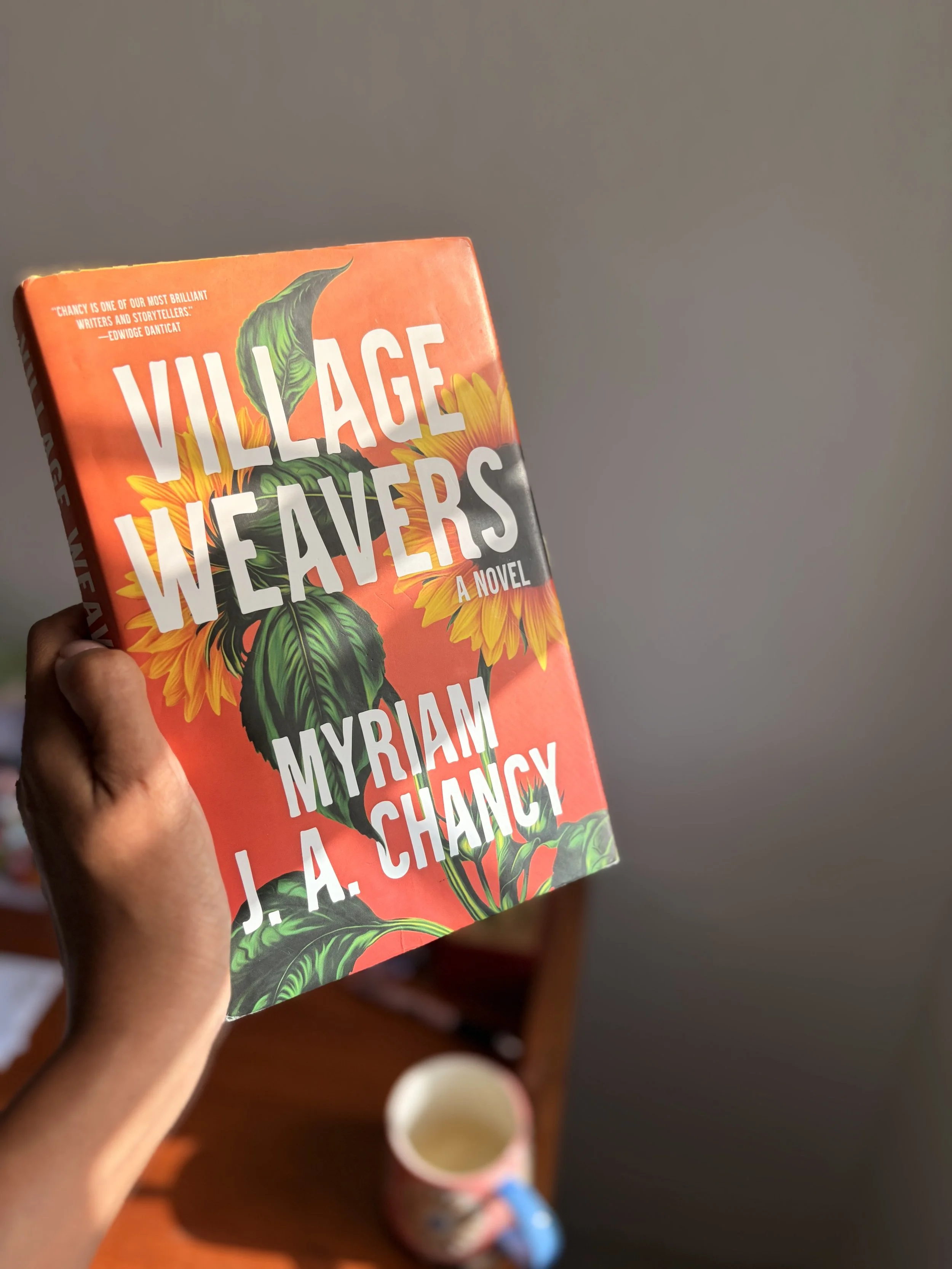
A photo of Village Weavers by Sarah-Anne Gresham. Taken in Antigua in September, 2026.
