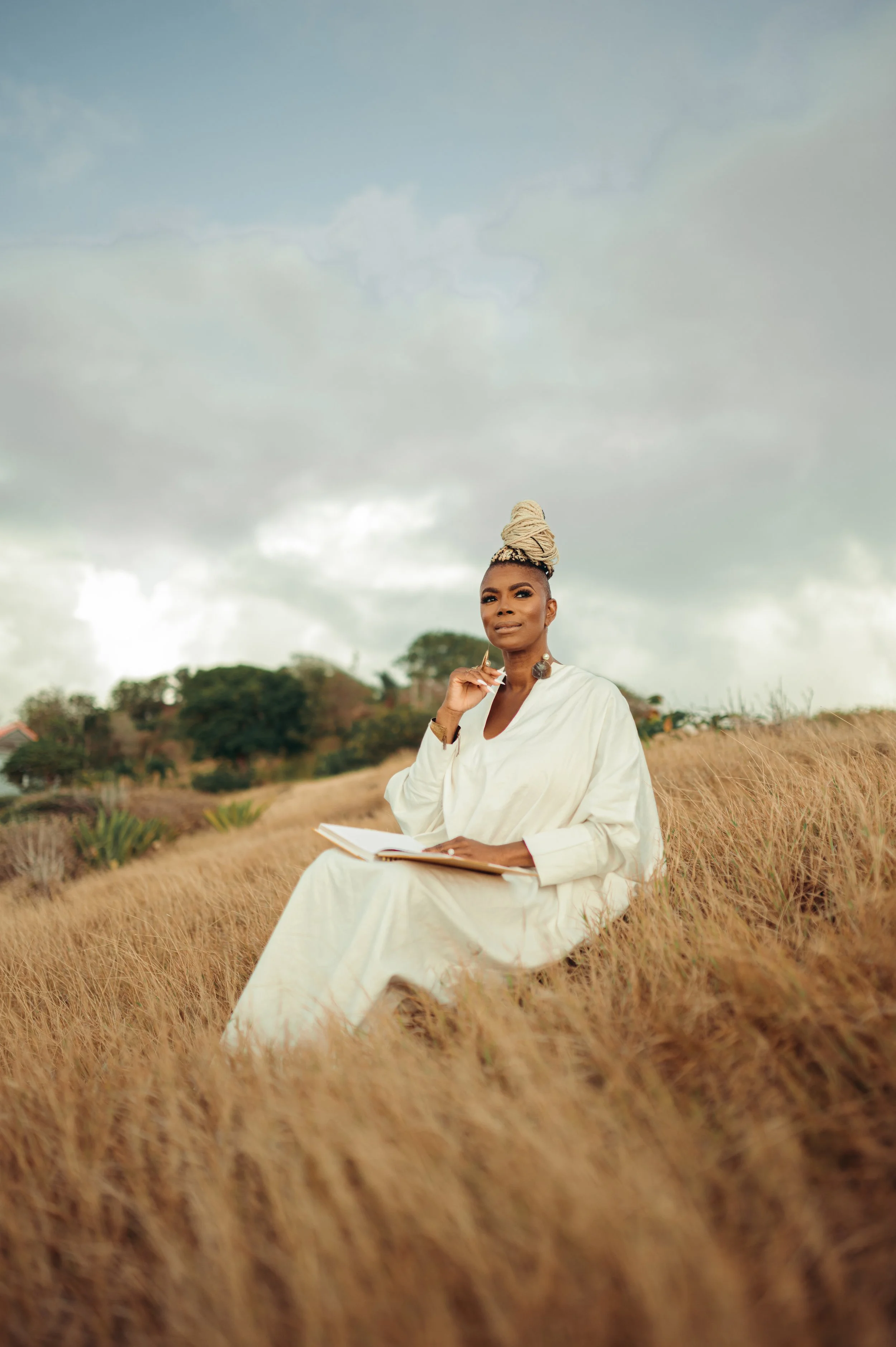
A photo of Karlyn Percil. She is wearing a white tunic and is sitting in a field with an open notebook.
“How do we build culturally rooted, somatic practices of well-being that can hold us through crisis without asking us to abandon ourselves or each other to survive?”
— Karlyn Percil
On August 27th, 17 people from Antigua and Barbuda, Trinidad and Tobago, Guyana, Grenada, St. Lucia, Belize, Jamaica, The Bahamas, Barbados, and the United States joined us in welcoming Karlyn Percil as our most recent healing justice facilitator. Ten of these participants attended previous healing justice sessions we hosted.
About the Session
Karlyn contextualized “Ancestral Wisdom as a Somatic Practice” with the following reflection and inquiry:
We are living through a moment of compounding crisis, ecological grief, and the slow erosion of the communities and cultures that once held us. Yet, in the midst of it all, something keeps us hopeful and connected. Across the Caribbean and the diaspora, generations have survived and imagined beyond crisis through healing, music, dance, play, ceremony, creativity, kinship, and collective care.
These are wellness practices as much as they are cultural narratives anchored in identity, belonging, and the wisdom to navigate uncertainty without losing oneself. Yet these knowledge systems have been dismissed, extracted, and rendered invisible, replaced by Western frameworks.
Drawing on Sylvia Wynter's invitation to think beyond narrow definitions of the human, alongside the work of Audre Lorde, land-based traditions, and culturally rooted somatic intelligence, this session asks: what becomes possible when we stop outsourcing our healing and come home to what our lineages already know?
— Karlyn Percil
Karlyn invited our Caribbean and transnational feminist audience to reflect on Derek Walcott’s poem, “Love After Love,” through a healing justice lens, with each participant choosing a line or turn of phrase from the poem that resonated with them.
Karlyn also introduced participants to the Medicine Wheel of the Dagara people from West Africa to disrupt Western-centric knowledge systems about wellness and healing justice. She also named three ingredients of emotions as a helpful framework for understanding and responding to our bodyminds: i) How one feels in one’s body, ii) What one says to oneself, and iii) What one does.
“What becomes possible when we stop outsourcing our healing and come home to what our lineages already know?”
Session Insights and Prompts
Not being well under capitalism is being well.
Identity formation is always in process.
Colonialism imposed restrictive identity categories and robbed us of the chance to make our own meaning of self.
“In the midst of uncertainty, I am still showing up by…” (name one thing you are doing well, even imperfectly).
“The trust bridge I am building right now looks like…” (examples include a relationship, a conversation, a commitment).
Participant Questions
“How do we not succumb to grief at the scale of racial injustice in the world?”
— MelVee, St. Lucia
“What did our ancestors do during and before colonization to process grief and transition?”
— Schessa, Belize
“How can we create wellness that is sustainable? That can move with us and ride the waves with us?”
— Raven, Guyana & Trinidad
“Human beings are magical. Bios and Logos. Words made flesh, muscle and bone animated by hope and desire,
belief materialized in deeds,
deeds which crystallize our actualities. ...And the maps of spring always have to be redrawn again, in undared forms.”
Participant Reflection
“The session came for me at a time where I am in great contemplation and rethinking my relationship to healing and being “well.” The concept that being unwell under capitalism is a sign of being well was brilliant to me, and it helped me to really sit with the things I’m experiencing through that lens. I really loved the Medicine Wheel. One thing that really stood out to me was Derek Walcott’s poem “Love After Love,” and how it took on a new life to me. During the session, I sat with it in a way that I had never done before. Lastly, since the session, I’ve begun asking more questions of what do I truly need from the people I am in relationship with and what precludes me from asking for those things?”
— Zoë, Antigua and Barbuda
About Karlyn Percil
Karlyn Percil is a Cultural Architect and field-builder with over two decades of practice at the convergence of neuro-emotional intelligence, ancestral wisdom, and cultural equity. She is the originator of Cultural Authorship, an emerging discipline that goes beyond traditional EQ and leadership models by centring the scholarship, wisdom, and lived intelligence of Black, Indigenous, non-gendered, and women-of-colour communities as foundational, not supplementary, to how we lead, heal, and organize.
As founder of KDPM Cultural Houses, encompassing the KDPM Equity Institute, SisterTalk Group Collective, and The Success System, Karlyn has built a body of proprietary research and frameworks, including the heritage-informed Cultural Susu -a Creative Capital & Cultural Leadership Assessment that translates ancestral wisdom and neuro-emotional intelligence into practical tools for cultural trust, psychological safety, and purpose-driven leadership. A sought-after speaker, coach, and trusted guide for personal, professional, purpose, and organizational transformation, Karlyn works with leaders, creatives, and institutions ready to move beyond surface-level inclusion toward whole, culturally rooted leadership.
