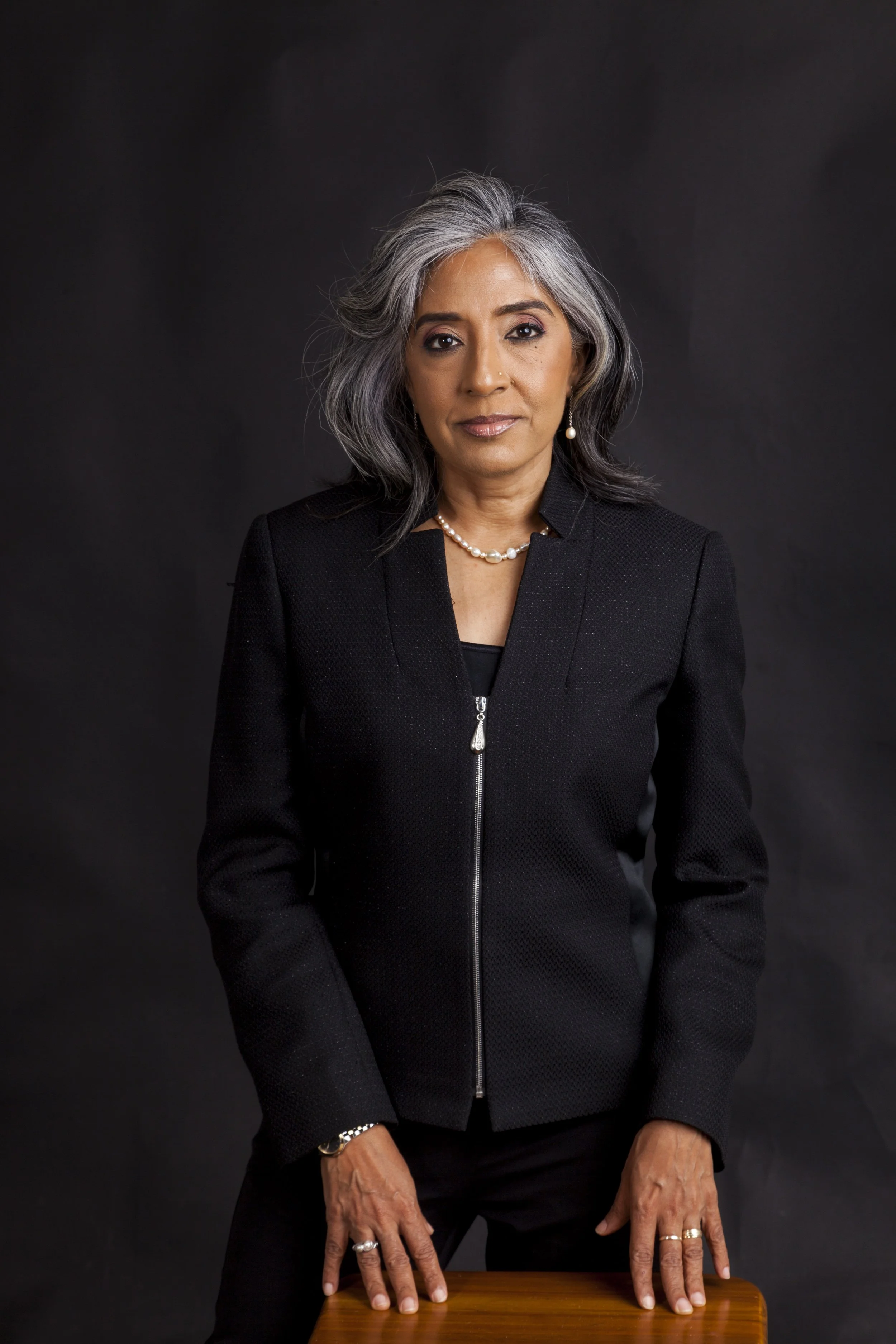
Photo of Dr. Gabrielle Hosein.
On May 13th, 2026, Intersect Antigua-Barbuda hosted its seventh virtual teach-in titled “Post-Indenture Feminist Politics and Indigenous Solidarity,” facilitated by Dr. Gabrielle Hosein.
At the Caribbean Institute in Gender and Development in 2017, a biennial summer programme I attended, Dr. Gabrielle Hosein discussed Caribbean and Indigenous feminist thought having its own distinct history, stretching across the precolonial Caribbean, to slavery, and to indentureship. Today, Dr. Hosein’s work insists upon an understanding of post-indenture history as shaping the entire region and impacting both Indian and non-Indian people. To this point, she foregrounds the importance of correcting assumptions that post-indenture histories exist in a discrete relationship with other historical structures organized by coloniality. Rather, it intersects with, shapes, and is shaped by histories of Indigenous dispossession, the enslavement of Africans, and decolonization movements.
Echoing Tuck and Yang’s critique on the appropriation of “decolonization” in ways that recenter and ensure settler futurity, thereby peripheralizing the repatriation of Indigenous land, Dr. Hosein writes, in Diary of a Working Mother, that “colonization, here, isn’t a metaphor. It’s the governing principle under which indigenous people dream of land, life and solidarity.” She follows this with an anticolonial political ethos: “Engaging each other to imagine freedom outside of colonial terms is ethical, urgent and necessary.”
Session Insights
Dr. Hosein shared the following incisive and historically grounded reflections:
The Caribbean and its people exist in an Indigenous geography, which is the most important context for thinking across colonial histories and conditions of coerced and exploitative labour.
Indo-Caribbean feminisms draw on histories of women, men, and gender expansive people who came to the Caribbean as indentured workers and survived plantation economies.
Indo-Caribbean feminism is circumscribed by a matrilineal genealogy that includes women’s labour histories, from their reproductive labour in the private sphere to their labour in the public sphere. These histories are integral points of departure for engaging Indo-Caribbean feminisms.
Indo-Caribbean women’s labour histories stretch across historical contexts of Indigenous dispossession, Indigenous genocide, and African enslavement.
Memory, femininity, tradition, agency, autonomy, protest, and pleasure are all cited by Dr. Hosein as constitutive frameworks through which Indo-Caribbean feminisms are engaged and understood.
““Engaging each other to imagine freedom outside of colonial terms is ethical, urgent, and necessary.””
Colonial authorities, along with laymen and patriarchal institutions that included the church, constructed the myth of the Indian woman as docile and domesticated to socially inscribe and stabilize the “British experiment” of nuclear and patriarchal family systems. Indo-Caribbean feminisms contest the assumptions that this colonial experiment produced, including assumptions of heterosexuality and normative formations of gender, race, and ethnicity. Also inherent within Indo-Caribbean feminisms are critiques of empire, including colonial empires and contemporary corporate empires, within a global political economy.
Indo-Caribbean feminism is also an interlocutor with Indo-Caribbean masculinities and reframes controlling stereotypes that cast them as inherently regressive and anti-Black. Dr. Hosein traced the progressive political histories of Indo-Caribbean men, including inroads made in cross-racial and cross-class solidarities.
From Indo-Caribbean Feminisms to Post-Indenture Feminisms
Dr. Hosein describes post-indenture feminisms as categorically distinct from Indo-Caribbean feminisms. Drawing on the scholarly text, Indo-Caribbean Feminist Thought: Genealogies, Theories, Enactments, which she edited with Dr. Lisa Outar, “post-indenture feminisms” is defined as:
…feminist thought founded upon the gender negotiations that directly came out of plantation life and the class, ethnic, sexual, and other shifts, relations, and identities that emerged from that particular political-economic configuration. p. 6
In theoretical dialogue with Dr. Patricia Mohammed’s scholarly contributions in Gender Negotiations among Indians in Trinidad, 1917–1947, “gender negotiations,” like the “feminist navigations” named in Indo-Caribbean Feminist Thought, encompass women [who] “‘strategize’ within constraints determined by patriarchal gender ideologies” (p. 22), including, as expressed by Dr. Mohammed, “flaunting or following rules when they had to.”
Caribbean feminisms writ large fall within a broader theoretical and historical scope of post-indenture feminisms. Indo-Caribbean feminisms, by way of example, constitute, per Hosein, “only one instantiation, only one representation, only one expression of post-indentureship feminism.” This conceptual reframing from Indo-Caribbean to post-indenture feminisms allows for a more historically grounded assemblage of contingent and mutable configurations of gender, race, ethnicity, and sexuality in the legacy of the post-indenture period and structure. This 96-year+ indenture period between 1834 and the 1930s is one that completely transformed the Caribbean and its people across race, ethnic, gender, and class differences.
Participant Reflection
In reflecting on what Dr. Hosein’s teach-in offered, a participant shared the following insight:
“It allowed me to truly think deeply about the context in which I exist as a feminist in the Caribbean. Not only did I think about my female Indian ancestors whose feminist fire runs through my veins but also those who existed long before my ancestors' arrival, whose voices are often silenced.”
— Stephanie, Trinidad and Tobago
Access Intersect’s playlist of clips from Dr. Hosein’s teach-in.
Session texts
"Post 213." Diary of a mothering worker (2016) by Gabrielle Hosein
"Post 249." Diary of a mothering worker (2017) by Gabrielle Hosein
"Post 493." Diary of a mothering worker (2023) by Gabrielle Hosein
"Freedom Denied: Indian Women and Indentureship in Trinidad and Tobago, 1845-1917" by Rhoda Reddock
More reflections from this teach-in are forthcoming in a post-session handout that you will be able to take with you into the world. Stay tuned!
About Dr. Gabrielle Hosein
Gabrielle Jamela Hosein is Senior Lecturer at The University of the West Indies, St. Augustine. She has been part of Caribbean feminist movement-building for thirty years. Her current areas of research include post-indenture feminisms, masculinities and adolescent sexualities. She is the co-editor of the collections, Negotiating Gender, Policy and Politics in the Caribbean: Feminist Strategies, Masculinist Resistance and Transformational Possibilities, and Indo-Caribbean Feminist Thought: Genealogies, Theories, Enactments.
Her national newspaper column, Diary of a Mothering Worker, was published from 2012 – 2026 in the Trinidad Guardian and Newsday. She was awarded the national Medal for the Development of Women (Gold) in 2022. Recently, she has been using Jouvay for post-indenture memorialisation through, for example, her mas character, Nachorious. In 2025, her art exhibition, The Botanical Afterlife of Indenture: Imaginative Archives, was held at the Art Society of Trinidad and Tobago.
