Saltwater Healing with Dr. Angelique Nixon
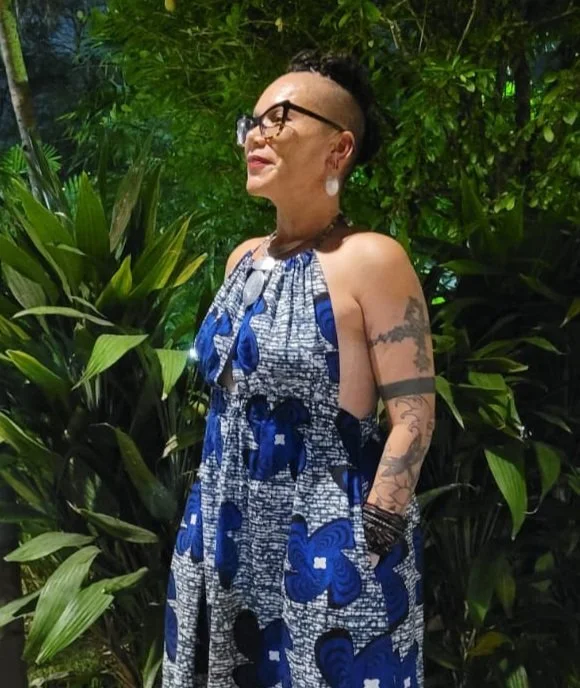
On July 16th, 2026, Dr. Angelique Nixon joined Intersect Antigua-Barbuda for an intimate gathering centered on healing justice, titled “Saltwater Healing and Community Care in the Caribbean.”
This session was oriented around several guiding questions:
1. How has coloniality affected our sense of community and our identities (gender, racial, sexual, cultural, etc.)? How has it affected our understanding of nature?
2. What is your relationship to community and nature? How do you understand yourself as part of communal and ecological systems (land and seascapes)?
3. What are your politics of care – for self, community, and the environment?
The Elements of Decolonial Healing Justice
To prepare for the session, participants were invited to watch her TEDx talk titled “The Elements of Decolonial Healing Justice,” which includes “burn, resist, act, care, [and] elevate.” She cites the current political structure of crisis in which we find ourselves as having historical continuity with the “slave trade, [Indigenous] genocide, and colonization,” as well as environmental destruction. Healing justice becomes an imperative under these fraught conditions, starting with an anticolonial, trauma-informed care of self that extends into the communal.
"The Caribbean sea and these islands bear witness to extraction, exploitation, dependence, vulnerability, and new kinds of colonial rule. Colonialism still impacts us today, even if we don't fully see it."
"We must confront power and 3/4 privilege, silences about race, class, antiblackness, and colorism. We must reject respectability and harmful gender norms. Embrace spiritual practices of our ancestors and build a regional identity with Indigenous and First Peoples at the center."
— Dr. Angelique Nixon
Saltwater Healing
Dr. Nixon is the author of the limited edition “myth memoir” Saltwater Healing, which was written at the intersection of art, healing justice, decoloniality, and environmental justice. It is contextualized as “method, art, and memory” in a recent interview in which she cites The Bahamas as exemplifying the ways that Caribbean people are “more saltwater than…land,” which shapes their relationship to geographic space.
Saltwater Healing is in conversation with her essay, “Water,” in the recently published text Thinking from Black: A Lexicon edited by Kaiama Glover, Canisia Lubrin, Tavia Nyong’o, Christina Sharpe, and Alexander Weheliye.
In this entry, Dr. Nixon names Black Caribbean fugitivity as being forged through water:
“In the Caribbean, rivers, swamps, coastlines, and forests share stories of rebellion. They offered refuge to enslaved Africans plotting vengeance, rebellions, and escape. Conch shells, river stones, and drums led the way to revolts and uprisings. Water is an archive, a witness, and a web of interdependence among all living beings and ecosystems. Maroon communities survived in harsh environments (from mangrove swamps to mountains) and learned to conceal and defend themselves in extraordinary ways. Gone to bush, warfare strategies, escape by sea, fly back to Africa, watering ways to freedom.”
— “Water,” Thinking from Black: A Lexicon, p. 300
She also identifies the boundary separating salt and freshwater as liminal and evocative of African spiritual traditions indicted by colonial administrations, noting that it is a “pathway…where the known world and the spirit world meet, inhabited by ancestors and spirits.” (p. 302)
“From 1821 to 1861, the “Saltwater Railroad” emerged—a coastal waterway between Florida and the Bahamas through which enslaved people escaped the American South and found refuge in the then British-controlled Bahamas.”
The session orbited around nature, the body, and artivism, with Dr. Nixon bringing her deep insights concerning the colonial history of water, and its resistant force as saltwater, to bear on healing justice.
The opening question about nature impacted me the most. Environmental justice is a field I've been navigating for the past couple of years. So the dialogue around that subject was heavy on my spirit. However, I loved the insight Angelique brought to the discussion.
— Timothy, The Bahamas
Additional post-session resources for this healing justice session are forthcoming.
About Dr. Angelique Nixon
Angelique V. Nixon is a Black queer writer, artist, scholar, and activist, born and raised in The Bahamas, and based in Trinidad and Tobago since 2014. She is a senior lecturer at The UWI’s Institute for Gender and Development Studies, and she is a director of the feminist LGBTQI+ organisation CAISO: Sex and Gender Justice in Trinidad and Tobago. She is the author of the art and poetry chapbook, Saltwater Healing: Myth Memoir & Poems (2013) and the scholarly award-winning book, Resisting Paradise: Tourism, Diaspora, and Sexuality in Caribbean Culture (2015). She is also co-editor of the forthcoming edited collection, Black Feminist Theories: Transnational Approaches (2026).
With over 20+ years of experience and leadership, Angelique has been a community organiser across civil society and academic institutions to bridge gaps and activate social transformation in working for justice. Her research and community work focus on intersecting issues related to social and climate justice, race and migration, and sexual and LGBTQI+ rights. She is fiercely committed in her work to intersectional queer feminist praxis, decolonial healing, environmental justice, and Black liberation.
Caribbean Affirmations: A Healing Justice Resource
by Dr. Angelique Nixon
