

Intersectionality in Transnational Contexts
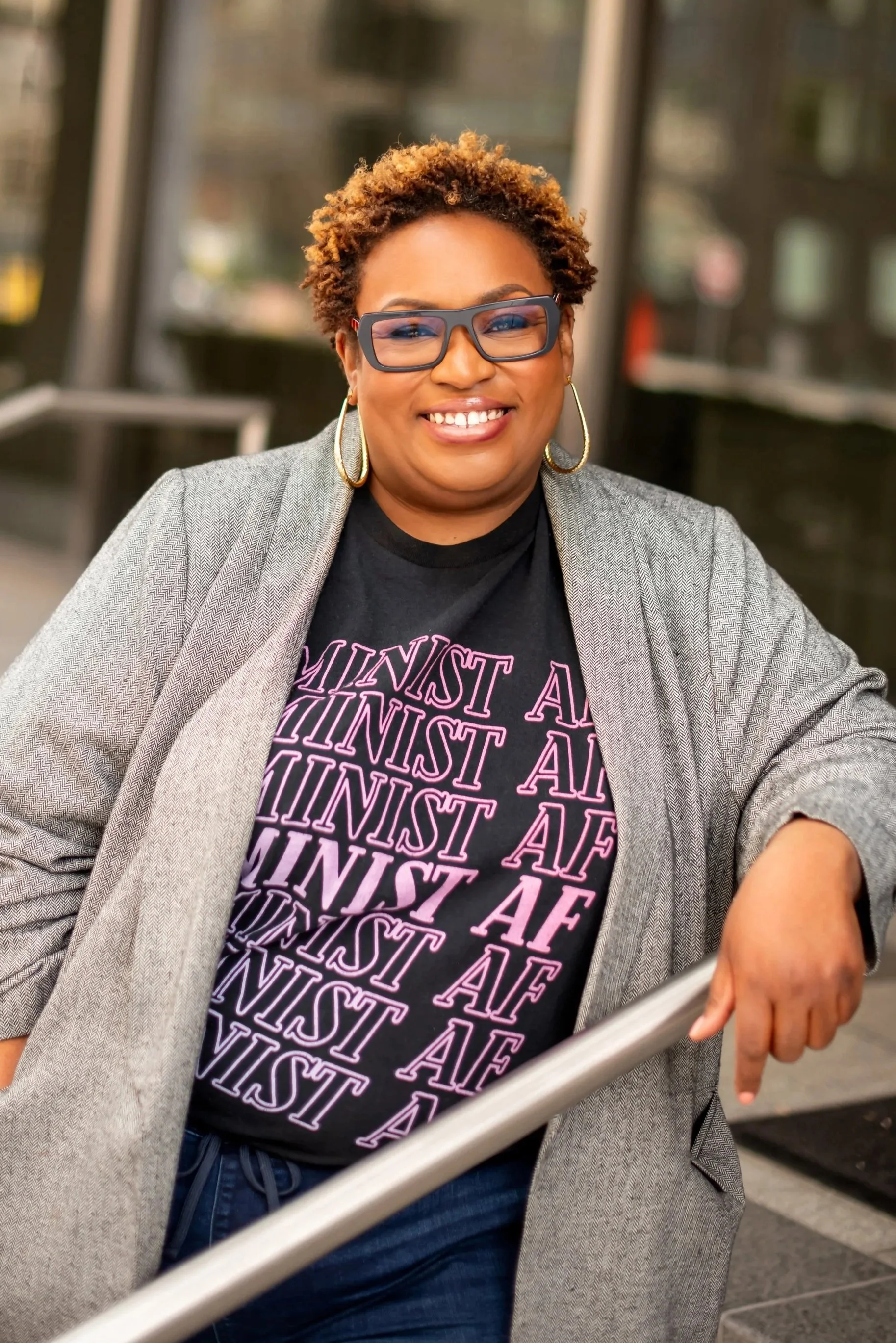
Photo of Dr. Brittney Cooper.
On July 2nd, 2024, Intersect Antigua-Barbuda hosted its second virtual teach-in titled “Intersectionality in Transnational Contexts,” facilitated by Dr. Brittney Cooper.
Dr. Cooper’s session attended to the travel of intersectionality—and “its core analytic frames of race, class, and gender”—to the Caribbean, through June Jordan’s essay, “Report from the Bahamas.” Dr. Cooper discussed the generative potential and limitations of intersectionality as a theoretical framework and method for building transnational Black feminist solidarity, as she outlined below.
Key Inquiries
Is intersectionality a useful analytic for building transnational Black feminist solidarity?
What are some ways that American understandings of race, class, and gender work against the building of such coalitions?
How does Black feminism help us mediate between what Jordan calls our "common identity" and the "individual identities" we may choose when our choices change?
Throughout this teach-in, Dr. Cooper urged a re-thinking of intersectionality, not as “a totalizing theory of identity,” but as an account of structural power and a theory for understanding violence.
“To treat intersectionality as an account of identity is to shear the framework of its radical potential and make it easily co-optable for neoliberal aims.”
In our post-session handout, I wrote that the Combahee River Collective (CRC) articulated the contours and substance of what we recognize today as "intersectionality," further developed and popularized by Kimberlé Crenshaw.
The CRC responded to the peripheralising of Black women's specific positionality across multiple categories of oppression in the United States’ civil rights movement, as well as its women's movement, which recognised “Black men” and “white women,” respectively, as quintessential aggrieved subjects in race-related and gender/sex-related matters. Black women as people harmed at the intersection of race and gender disappear as a recognizable class.
Dr. Cooper expressed “race” and “gender” as axes of power that are co-produced through systems of white supremacist-capitalist-patriarchy, which produce identities and place people inside of them.
Through the work of June Jordan, she also invited participants to think about “class” and “nation” to attend to the ways that Black women beyond the United States, including the Bahamian domestic worker in Jordan’s essay, complicate the possibilities of what intersectionality can do when it travels.
“It was our experience and disillusionment within these liberation movements, as well as experience on the periphery of the white male left, that led to the need to develop a politics that was anti-racist, unlike those of white women, and anti-sexist, unlike those of Black and white men.”
A question I posed in our handout is whether juridical frameworks function as the only legitimizing apparatus to correct the illegibility of Black women’s structurally produced precarity. What do we find when we hold the tensions induced by “legibility,” by acknowledging what it simultaneously offers and forecloses?
Referencing Crenshaw, Dr. Cooper maintained the following reflection:
“[the] failure to begin with an intersectional frame would always result in insufficient attention to Black women’s experiences of subordination. She did not argue for the converse, namely, that intersectionality would fully and wholly account for the range or depth of Black female experiences.”
Resources
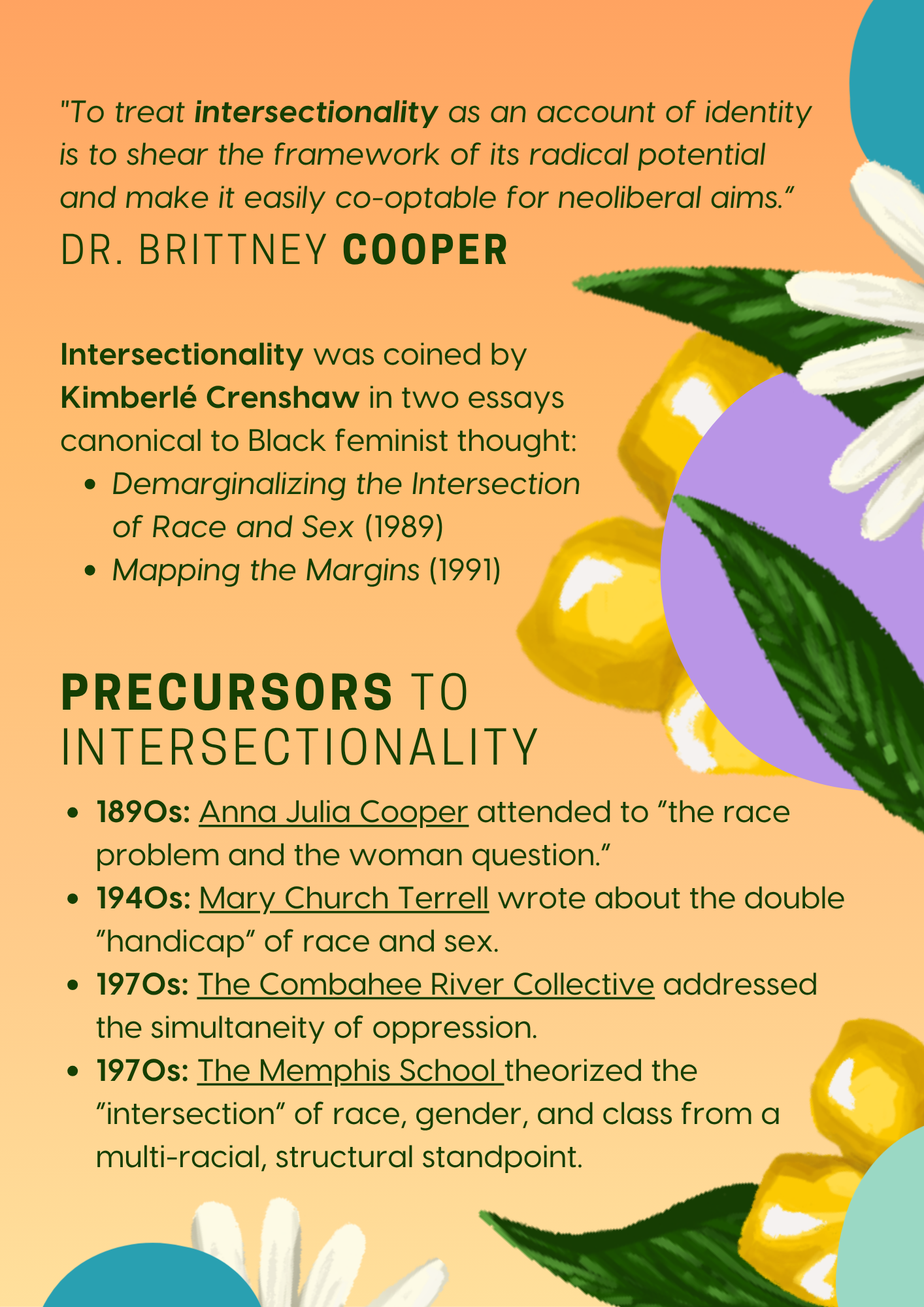
Understanding Intersectionality
Access our playlist of clips from this teach-in.
Participant Reflections
“[This session] provided language and resources to articulate my lived experience as a child of the diaspora who's been keenly aware of intersectionality since early childhood. It was a pleasant refresher in academia for some of the intersectional feminist work I'm now involved in in Jamaica.”
— Rica, Jamaica & USA
“I gained much clarity on intersectionality as a discussion of power and not one based on identity, and how these notions can then be used to challenge the colonial-based systems and legacies that remain so entrenched in our daily lives. I was able to now look at intersectionality not as a total construction of self, but intersectionality as a controlling force of self by the other (that being colonialism, capitalism, and white supremacy). I believe that once we have gotten to this point of psychological decolonialization, the self that is the Black woman can be fully reclaimed.”
— Solange, Trinidad & Tobago
About Dr. Brittney Cooper
Brittney Cooper is Professor of Women’s, Gender, and Sexuality Studies and Africana Studies. Prof. Cooper is also the Principal Investigator and Founding Director of the Race and Gender Equity (RAGE) Lab at Rutgers.
Her books include Beyond Respectability: The Intellectual Thought of Race Women, winner of the 2018 Merle Curti Prize for Best Book in U.S. Intellectual History from the Organization of American Historians; the New York Times bestseller Eloquent Rage: A Black Feminist Discovers Her Superpower; Feminist AF: A Guide to Crushing Girlhood (co-authored with Susana Morris and Chanel Craft Tanner) a Kirkus top Young Adult Book of 2021 and a nominee for the Garden State Teen Book Award from the New Jersey Library Association; Stand Up!: 10 Mighty Women Who Made a Change; and The Crunk Feminist Collection (co-edited with Susana Morris and Robin Boylorn).
Cooper co-founded the Crunk Feminist Collective, a Hip Hop Generation Feminist Collective of Women of Color Activists and Scholars. They ran the highly successful Crunk Feminist Collective Blog which was named a top blog by New York Magazine in 2011. Today, they co-edit The Remix, a weekly substack newsletter.
