

The Transnational Politics of June Jordan

Photo of monaye johnson.
On August 18, 2024, Intersect Antigua-Barbuda hosted its third virtual teach-in titled “The Transnational Politics of June Jordan: Bringing Back Anti-Imperialist Black Feminisms,” facilitated by Ph.D. student monaye johnson.
This Caribbean feminist teach-in explored the radical transnational politics of June Jordan embedded in her writings, explored the concept of transitional solidarity, and provided insights on the dangers of erasing the anti-imperialist aspects of Black feminisms. Breya underscored June Jordan’s commitment to a revolutionary, transnational, black feminist politic—encouraging us to do the same—by delving into her life and several of her essays from Some of Us Did Not Die, including Many Rivers to Cross, Civil Wars, and Nicaragua: Why I Had to Go There.
Key Inquiries
What happens when we uplift June Jordan with her transnational politics?
What were June Jordan’s stances?
Is Palestine still the moral litmus test of our movements?
Our facilitator, monaye johnson, led a powerful teach-in discussing the political life of the warrior poet, June Jordan, whose storied Black feminist history traversed love, family, and Black survival. She was anti-war and anti-imperialist.
monaye foregrounded the importance of engaging Jordan’s poetry in order to understand her transnational politics. Jordan used poetry as a mechanism for radical, direct action and change. She understood the power of language, and as a result, it became her weapon in a war where the wielding of words — from imperialist propaganda to feminist language and descriptors — has a tangible, material impact on our lives.
“Poetry means taking control of the language of your life. Good poems can interdict a suicide, rescue a love affair and build a revolution in which speaking and listening to somebody becomes the first and last purpose to every social encounter.”
As articulated by monaye, and as noted in our post-session handout, when June Jordan wrote about oppression and suffering, she did not want us to feel like collaborators in our own suffering, nor did she want us to endure it. She wanted us to move beyond enduring. As monaye reflects, “She wants to get us to a place where we can fight back, strategically.”
Resources
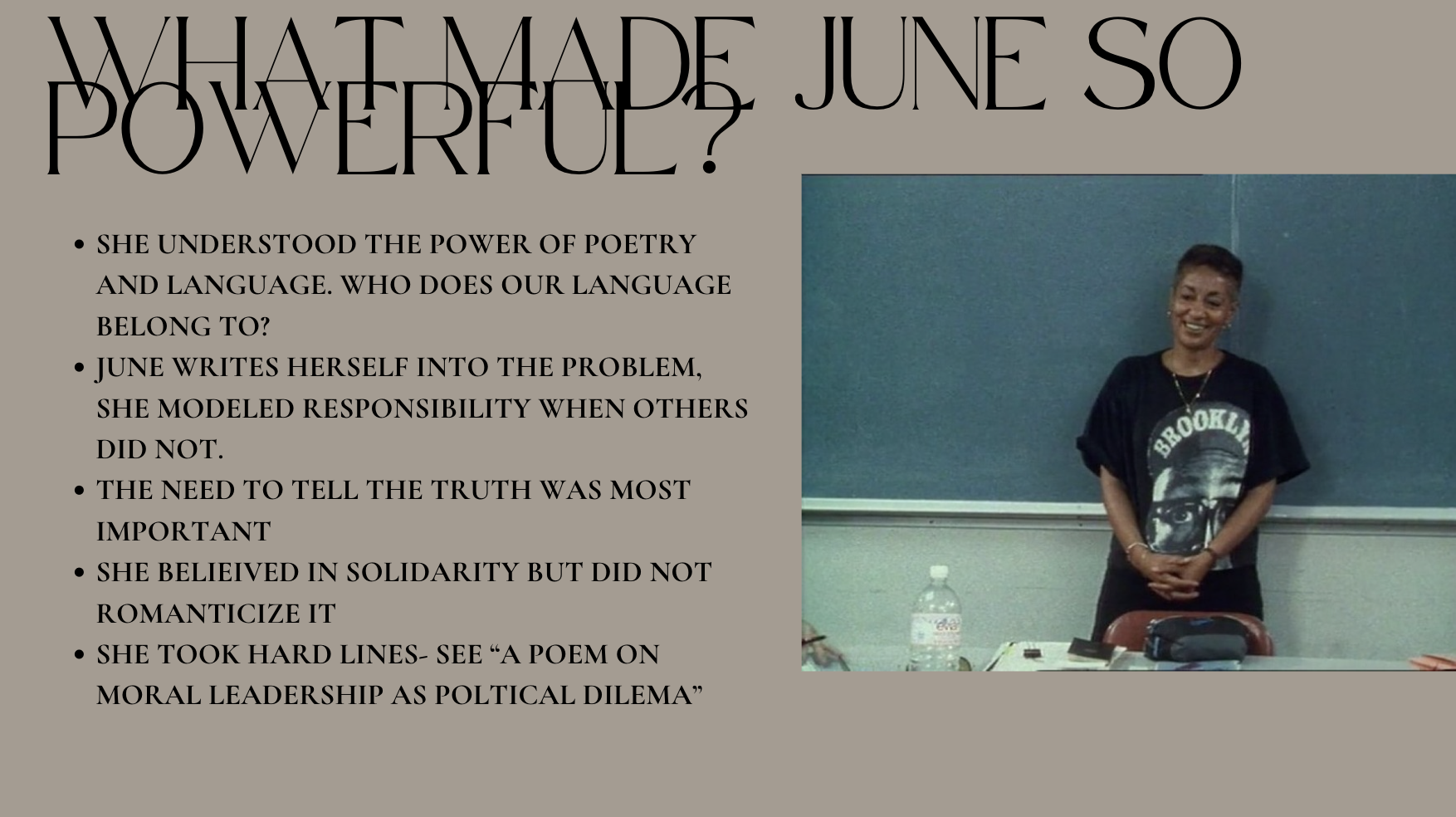
A screen capture of monaye’s presentation slide from the teach-in.
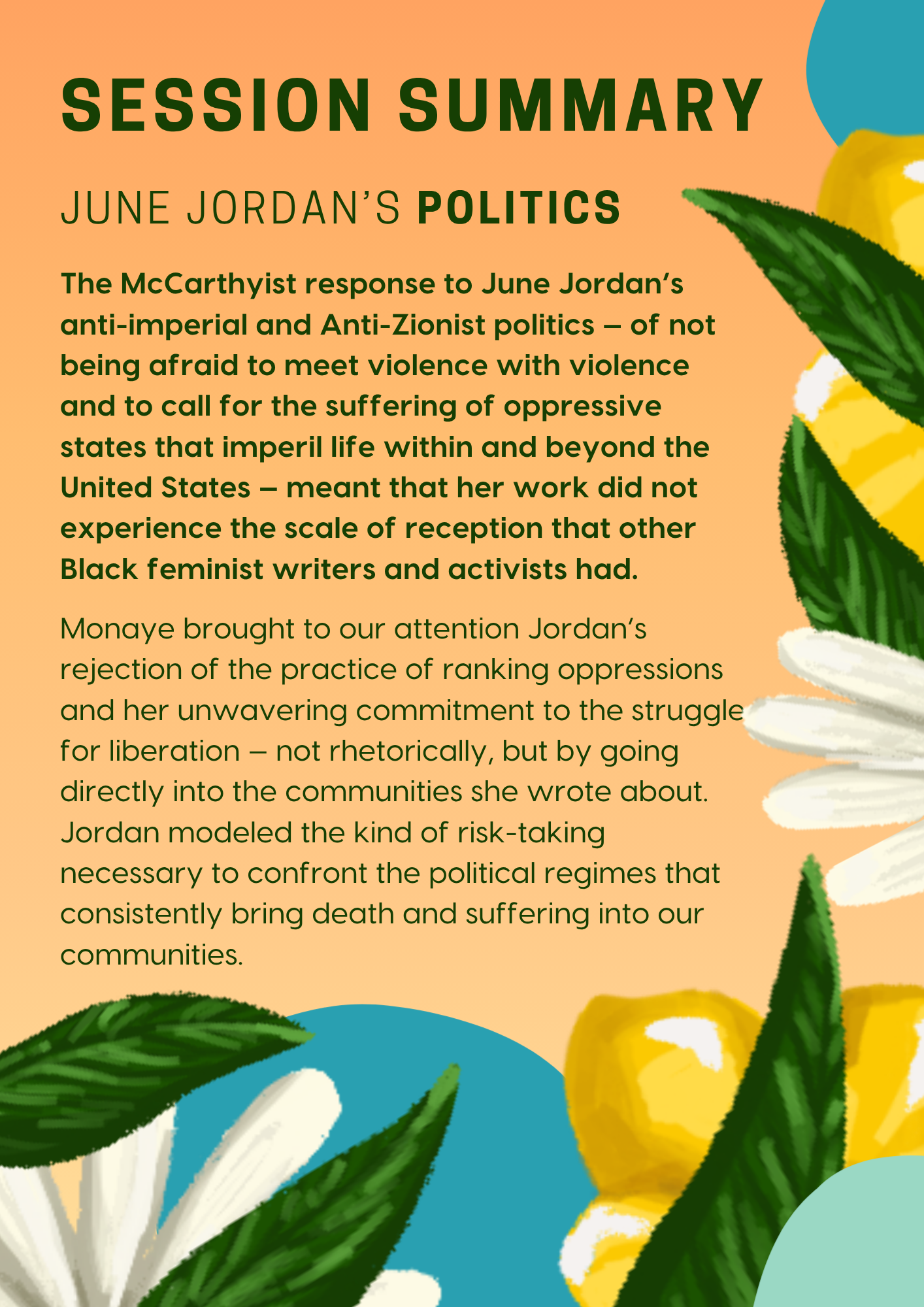
June Jordan’s Revolutionary Poetics
Access our playlist of clips from this session.
Participant Reflection
“I really enjoyed monaye’s methodology and contextualizing of her study of June Jordan; her clarity and generosity in sharing. Accessible scholarship is so vital.”
— Soraya, Haiti
About monaye johnson
monaye johnson (she/they) is a curator, abortion doula, and doctoral student in Africana Studies at Brown University whose work examines the affective, psychic, and grammatical structures that shape Black gendered life.
Drawing on Black feminist theory, psycho-affective analytics, and the intellectual legacy of thinkers such as Hortense Spillers and June Jordan, her/their research explores how desire, touch, and patriarchy operate within and beyond the afterlife of slavery.
She has delivered invited talks and lectures at Harvard, Yale, The New School, and international convenings on Black feminist thought, care ethics, and reproductive justice.
At Brown, she is a Mae Williamson Simmons Fellow, and her broader work spans public scholarship, political education, and organizing. monaye holds a B.A in Gender Studies & Psychology and a M.A in Gender Studies as well.
